The Death of the Gimbal: How the Antigravity A1 is Redefining Aerial Cinematography
For the modern traveler, the drone has become as essential as a passport. Whether navigating the rugged peaks of the Andes or the bustling neon corridors of Tokyo, content creators rely on these flying cameras to capture the "money shot"—the sweeping, cinematic reveal that defines a journey. Yet, the traditional drone experience has long been shackled by the limitations of mechanical gimbals and the frantic pressure of real-time manual framing.
Enter the Antigravity A1, a disruptive piece of hardware released in late 2025 that aims to render the gimbal obsolete. By shifting the paradigm from "capturing the moment" to "directing the memory," the A1 has fundamentally changed the workflow for solo travelers. Having spent significant time testing this unit, it is clear that we are witnessing a pivot point in consumer drone technology.
The Core Innovation: A Sphere of Vision
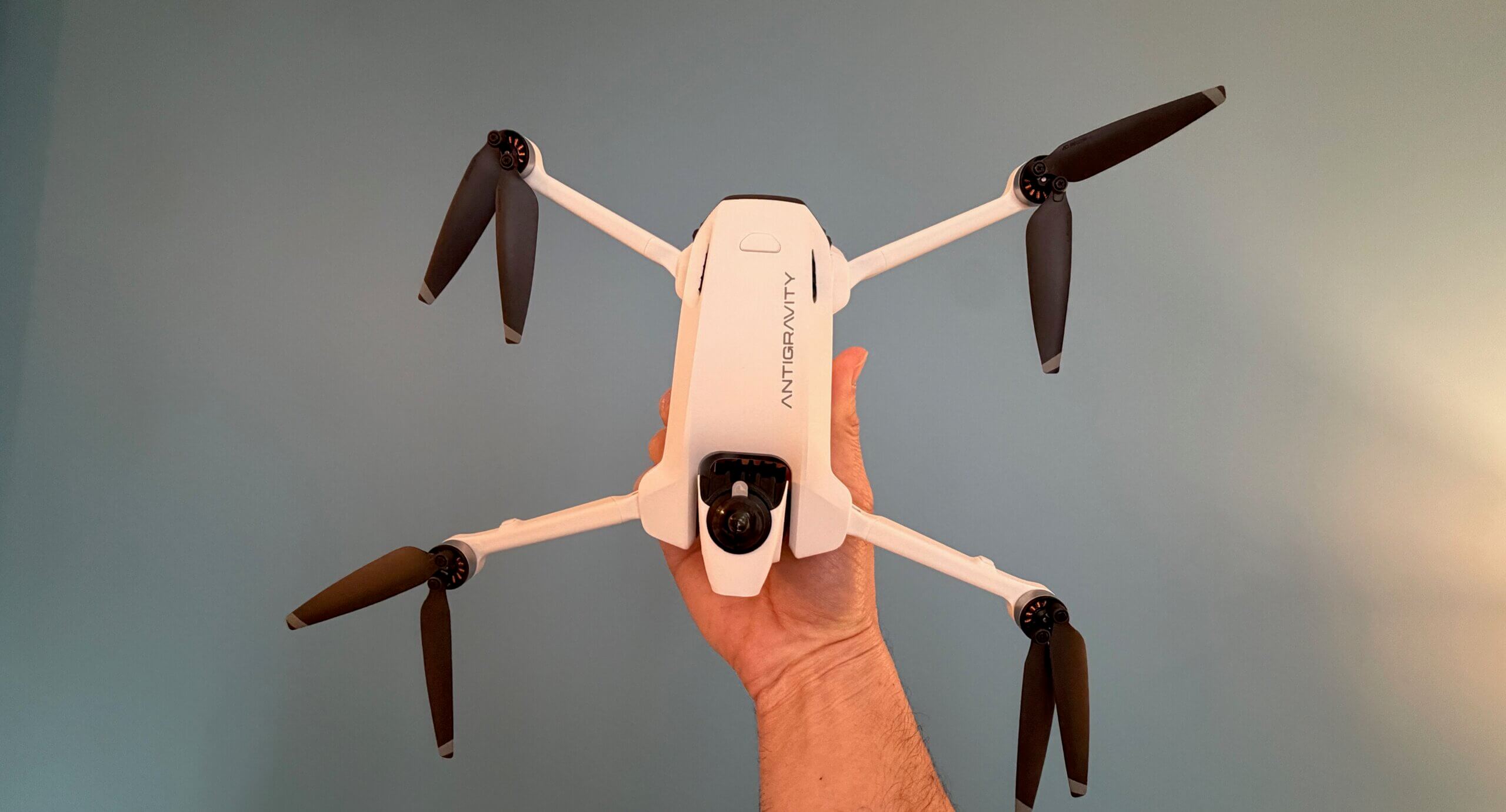
At the heart of the Antigravity A1’s appeal is its dual-lens 360-degree capture system. Unlike conventional drones that utilize a single, forward-facing lens mounted on a fragile, motorized gimbal, the A1 features two ultra-wide-angle lenses—one atop the fuselage and one beneath. Each captures a 200-degree field of view. When these images are stitched together in the onboard processor, they create a seamless 360-degree sphere of data.
This design choice has a profound secondary benefit: the "invisible" drone effect. Because the lenses capture everything around them, the software can digitally mask the aircraft’s body in the final export. The result is a surreal, floating perspective that looks less like a drone shot and more like an impossible camera movement—a feat that, until now, required expensive 360-rigs and heavy post-production work.
Hardware Specifications and Build Quality
The A1 does not sacrifice build quality for its innovative lens array. The chassis is constructed from a high-grade, carbon-fiber-reinforced polymer, providing a superior strength-to-weight ratio compared to the ABS plastics common in entry-level models.
Critically, Antigravity has engineered the unit to weigh exactly 249 grams with its standard battery. This is a strategic decision: in most aviation jurisdictions, 250 grams is the threshold for mandatory registration and complex commercial flight restrictions. By hugging this limit, the A1 remains legally nimble, allowing travelers to deploy it with minimal bureaucratic friction in most regions.
The Flight Experience: Immersion and Intuition
The A1 experience is defined by the Vision Goggles, which offer a tactile, first-person view of the flight path. These goggles feature dual 4K micro-OLED displays with a 120Hz refresh rate, providing a near-zero latency connection.
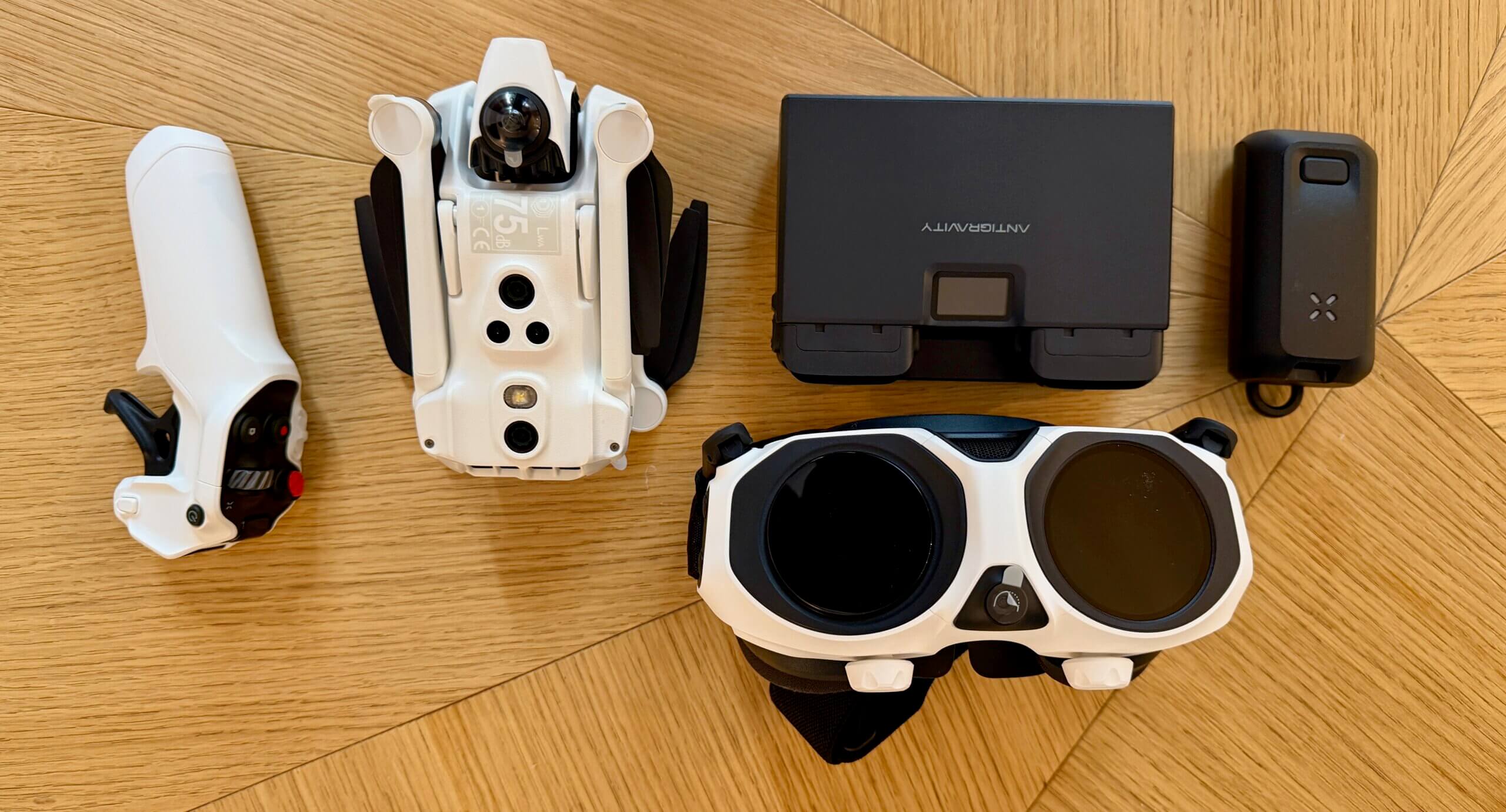
However, the real magic lies in the integrated head-tracking. Because the drone is constantly recording in a 360-degree sphere, the pilot is not tethered to a fixed forward view. By simply turning your head, the feed pans accordingly. Looking down through the goggles allows you to see the terrain passing directly beneath the drone, while a quick glance upward reveals the sky. This creates a level of spatial awareness that makes standard FPV (First Person View) flying feel remarkably restrictive by comparison.
Pilot Control Systems
The A1 ships with a single-handed motion controller that prioritizes ease of use. Accelerating is as simple as pulling a trigger, while banking and climbing are controlled via wrist tilts. It is a highly intuitive system, allowing beginners to navigate complex environments—like forest canopies or city alleyways—within minutes. While the company does offer a traditional "Mode 2" stick controller for professional FPV enthusiasts, the motion controller is so fluid that it is expected to become the industry standard for casual to semi-pro creators.
Technical Performance and Data Processing
The marketing material for the A1 boasts "8K Resolution," a term that requires context. In a standard rectangular camera, 8K is a dense grid of pixels. In a 360-degree camera, those pixels are stretched across a sphere. When the user "reframes" the footage for a standard 16:9 social media video, they are essentially cropping a portion of that sphere.
To compensate for this, Antigravity has invested heavily in color science. The A1 offers:
- Vivid Profile: Optimized for immediate social media sharing with high saturation and contrast.
- 10-bit Log Profile: A flat, professional color grade that retains maximum highlight and shadow data for post-production color grading.
The stabilization is handled by the proprietary "FlowState" algorithm. During field tests, even in 20mph winds, the footage remained unnervingly steady. It effectively replicates the performance of a high-end cinema tripod, despite the lack of a mechanical gimbal.
The Software Ecosystem: "Fly Now, Frame Later"
The true brilliance of the A1 lies in the Antigravity Studio app. Because the drone captures every angle simultaneously, the pilot no longer has to worry about losing the subject.
Using the smartphone’s gyroscope, a user can "re-film" their flight in the app. You simply play the video and move your phone around to frame the shot as if you were holding a real camera. For the solo traveler, the app’s "Auto-Frame" feature is a game changer. It utilizes AI to identify subjects—whether it’s a person hiking or a moving vehicle—and automatically generates a cut that keeps the subject centered and in focus. It is, for all intents and purposes, a virtual camera crew.
Operational Limitations and Trade-offs
No piece of technology is without its bottlenecks. The primary challenge remains battery life. The standard Intelligent Flight Battery offers a theoretical 24 minutes, though real-world conditions typically yield closer to 19 or 20 minutes.
While this sounds limiting, the "work per minute" ratio is significantly higher than that of a traditional drone. Because you never have to re-fly a path to capture a different angle, one 20-minute flight with the A1 is often more productive than three separate flights with a standard drone. For those who require extended endurance, a "Pro Battery" is available, though it pushes the weight above the 250-gram registration threshold.
Furthermore, while the sensors are impressive—1/1.28-inch CMOS units—they are smaller than the 1-inch sensors found in top-tier professional photography drones. They excel in low-light environments compared to traditional 360 action cameras, but professional cinematographers seeking extreme dynamic range will still find themselves reaching for larger, dedicated cinema rigs for high-end commercial work.
Implications for the Future of Content Creation
The Antigravity A1 marks a shift toward a more democratic form of aerial cinematography. By removing the technical anxiety of manual piloting and the physical limitation of gimbal movement, it allows the creator to focus entirely on the story.
The integration of "Turtle Mode"—which allows the drone to flip itself over if it lands upside down after a crash—is a subtle but critical inclusion. It acknowledges that creators are going to push these machines to their limits, and it ensures that the "walk of shame" to retrieve a downed drone is a thing of the past.
Final Verdict
The Antigravity A1 is a niche product that is rapidly becoming a mainstream necessity. It is the most exciting advancement in drone technology since the introduction of the folding frame. It bridges the gap between traditional cinematography and the immersive, interactive world of VR-ready content.
If you are a traveler who feels limited by the rigid perspective of standard drones, the A1 is an essential addition to your toolkit. It is a piece of technology that empowers the creator to be present in the moment, knowing that the "shot" is already safely stored in the sphere of data surrounding them. As we move into 2026, the A1 sets a high bar for competitors and offers a glimpse into a future where the camera is no longer a constraint, but an extension of the director’s eye.