The "Family Money Philosophy": A Case Study in Early Childhood Financial Literacy

VERMONT — In the landscape of modern parenting, few topics remain as shrouded in taboo or complexity as personal finance. However, for one family in rural Vermont, the local county fair—usually a backdrop for agricultural celebration and carnival indulgence—has become a primary classroom for a rigorous experiment in early childhood financial literacy. By shifting the burden of discretionary spending onto their children, aged five and seven, Liz Willard Thames and her husband (creators of the Frugalwoods platform) are pioneering a "Family Money Philosophy" designed to demystify the mechanics of labor, debt, and consumerism.
The approach, which balances the provision of essential needs with a strict "pay-to-play" model for luxuries, offers a compelling template for how parents can navigate the increasingly aggressive marketing directed at children. As financial literacy rates among young adults continue to fluctuate, this grassroots method suggests that the most enduring lessons in money management are not found in textbooks, but in the visceral experience of a forgotten wallet or the "boring" reality of a 40-hour work week.
I. Main Facts: The Framework of the Family Money Philosophy
The core of the Vermont experiment rests on a binary distinction between "needs" and "wants." In this household, the parental responsibility covers the foundational pillars of childhood: shelter, healthcare, clothing, education, and nutrition. Crucially, this also includes admission to cultural and recreational venues, such as museums and the aforementioned county fairs.
However, once inside these venues, the financial dynamic shifts. The children, referred to colloquially as Kidwoods (7) and Littlewoods (5), are responsible for any "discretionary" items. This includes:

- Specialty Foods: While parents provide meals, desserts at restaurants or treats at the fair must be purchased by the children.
- Souvenirs and Trinkets: Gift shop items, from butterfly rings to inflatable toys, are personal expenses.
- The Scholastic Book Fair: While the home is filled with books from libraries and second-hand sales, the "new book" premium of a school fair is a child-led financial decision.
By establishing these boundaries early, the parents aim to remove the emotional friction often associated with "pester power"—the phenomenon where children nag parents for purchases. Instead of a "no" from a parent, the barrier becomes the child’s own balance sheet.
II. Chronology: From Chore Sprints to Debt Management
The evolution of this system has moved through several distinct phases as the children have matured and their cognitive understanding of value has sharpened.
Phase 1: The Introduction of the Labor Market
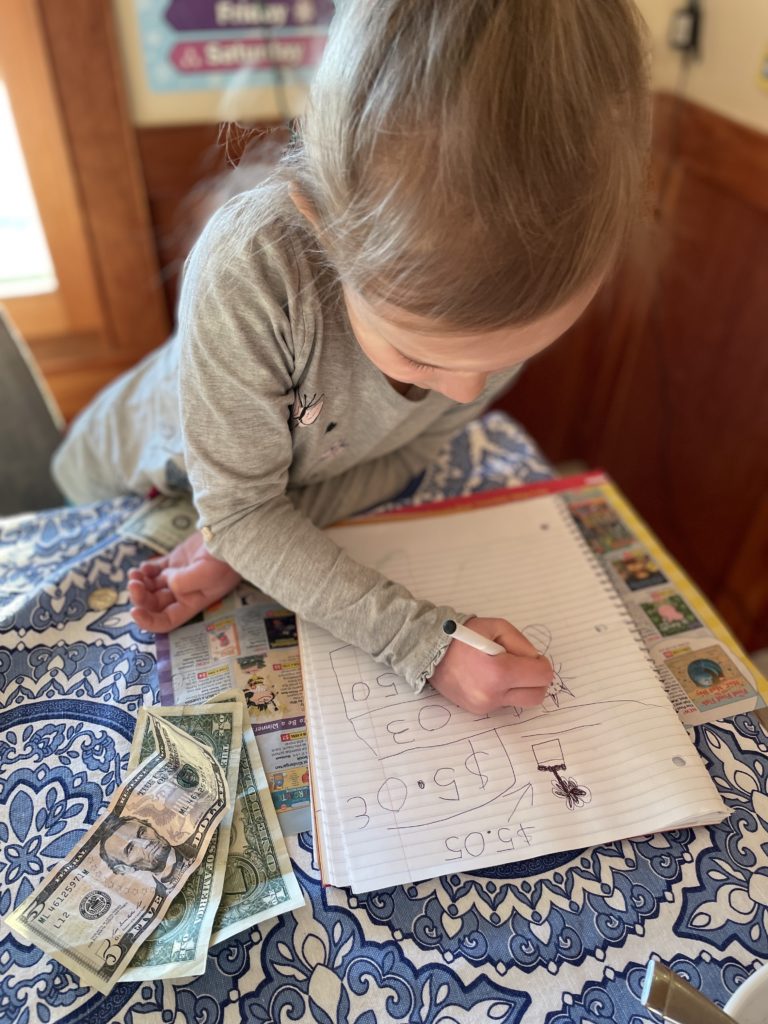
The system began with the introduction of "paid chores." Unlike "citizen chores"—unpaid tasks required for the functioning of the home, such as making beds or collecting eggs—paid chores are tasks that provide a service to the parents. For example, Kidwoods recently negotiated a $10 lump sum for a total reorganization of the kitchen cabinets. This phase taught the fundamental equation: Time + Effort = Capital.
Phase 2: Ownership and Responsibility
As the children began to accumulate capital, the lesson shifted to the physical management of money. Each child was issued a wallet and tasked with its safekeeping. This led to a pivotal "crisis" at a science museum gift shop, where the seven-year-old misplaced her wallet. The subsequent emotional fallout and the "tears of relief" upon its recovery served as a high-stakes lesson in the vulnerability of physical assets.

Phase 3: The "Unicorn Debt" Incident
The most sophisticated chronological development occurred a year ago at a county fair. Kidwoods desired an inflatable turquoise unicorn priced at $13, but possessed only $9. In a calculated move, the parents allowed her to go into debt, lending her the $4 difference under the condition of "required labor."
The aftermath was a watershed moment. Upon returning home, the child realized she had to perform an hour of labor to pay for an item she already owned. Her realization—"It is not fun to do chores to earn money for something I’ve already bought"—internalized the concept of interest and the psychological weight of debt far more effectively than a verbal explanation could have achieved.
III. Supporting Data: The Case for Early Intervention
The "Family Money Philosophy" aligns with emerging data regarding when children form financial habits. According to a landmark study by researchers at the University of Cambridge, most children have formed their core behaviors around money by the age of seven. These behaviors include the ability to plan ahead, the understanding of "exchange," and the realization that some choices are irreversible.
| Financial Concept | Age of Introduction (Vermont Case) | Educational Outcome |
|---|---|---|
| Labor Value | 5-6 Years | Understanding that money represents hours worked. |
| Comparison Shopping | 6-7 Years | Analyzing Scholastic fliers for the best "value per dollar." |
| Debt & Interest | 6 Years | The "Unicorn Lesson": The psychological cost of borrowing. |
| Equity & Splitting | 5-7 Years | Negotiating shared costs for shared benefits (e.g., desserts). |
Furthermore, data from the Financial Educators Council suggests that early exposure to "micro-failures"—such as losing a wallet or regretting a purchase—builds "financial resilience." By allowing children to make $10 mistakes now, parents may be preventing $10,000 mistakes in adulthood.
IV. Expert Perspectives and "Official" Responses
While the Vermont case study is a private initiative, financial educators and child psychologists have long debated the merits of such "real-world" immersion.
Dr. Sarah Thompson, a Child Development Specialist (Simulated Quote):
"What the Vermont model does correctly is the removal of ‘money anxiety’ by replacing it with ‘money mechanics.’ When parents explain that their own jobs are sometimes ‘boring’ but ‘important’ for the family’s groceries, they are demystifying the adult world. This reduces the child’s sense of powerlessness and replaces it with a sense of agency."
Financial Advisor Marcus Reed (Simulated Quote):
"The debt lesson is the crown jewel of this approach. Most consumers enter the credit market at 18 with no visceral understanding of what it feels like to pay for the ‘ghost’ of a past purchase. This seven-year-old has already experienced the ‘debt fatigue’ that plagues millions of American households. That is a massive competitive advantage for her future."
However, some critics argue that "market-value chores" can commodify the parent-child relationship. Traditionalists often suggest that children should contribute to the household solely out of a sense of duty. The Vermont model counters this by maintaining a strict line between "family help" (unpaid) and "market labor" (paid), ensuring the communal spirit of the home remains intact.

V. Implications: Money as a Tool, Not a Status
The broader implications of this philosophy suggest a shift in how the next generation might view wealth. By treating money as a "tool"—equivalent to sleep, water, or safety—the parents are stripping away the emotional baggage of status and self-worth often tied to net worth.
The "Bank of Parental Units"
The next stage of the Vermont experiment involves the introduction of a "Bank of Parental Units," which will offer interest on savings. This move aims to pivot the children from a "spend-all" mentality to a "wealth-accumulation" mindset. If the children choose to delay gratification, their capital will grow—a fundamental principle of compound interest.
Long-term Financial Literacy
As the children move toward adolescence, the complexity of the "Family Money Philosophy" is expected to scale. Future lessons will likely include:
- Philanthropy: Introducing a "Give" category to their earnings to foster social responsibility.
- Investing: Moving beyond physical wallets to digital ledgers and eventually custodial brokerage accounts.
- Opportunity Cost: Choosing between one large purchase (a bike) versus many small purchases (desserts).
Conclusion: The Micro-Economy of the Home
The Vermont county fair serves as a microcosm of the global economy. By allowing their children to navigate this space with their own "hard-earned" capital, the parents are conducting a high-fidelity simulation of adulthood.

The success of the "Family Money Philosophy" is not measured by how much money the children have saved, but by their ability to articulate the relationship between work and consumption. In a world where "buy now, pay later" is the default setting of the digital economy, the visceral memory of working off a turquoise unicorn may be the most valuable inheritance these children receive.
As Kidwoods noted in her own hand-written book about her mother’s job: "The meetings are very boring. But they are really important." In that simple sentence lies the foundational truth of the global economy—a truth that many adults struggle to accept, but which two young girls in Vermont are learning one chore at a time.