The Paradox of Choice: When Healthy Options Lead to Unhealthier Decisions
Main Facts
In a counterintuitive twist on human psychology, the very presence of healthy food options or readily available nutritional information can inadvertently steer consumers towards making significantly unhealthier choices. Far from empowering individuals to adopt better dietary habits, these well-intentionintentioned interventions often trigger a complex array of cognitive biases, including self-licensing, vicarious goal fulfillment, the "what the hell effect," and the pervasive health halo effect, ultimately undermining public health objectives. This perplexing phenomenon challenges conventional wisdom about consumer behavior and necessitates a deeper understanding of the psychological undercurrents influencing our daily food decisions.
The Unforeseen Failure of Calorie Labeling
The year 2017 marked a significant moment in public health policy when national chain restaurants in the United States were mandated to display calorie counts on their menus. This initiative, met with considerable fanfare, was founded on the seemingly logical premise that informed consumers would naturally gravitate towards healthier, lower-calorie options, thereby curbing the escalating rates of obesity and diet-related diseases. The expectation was straightforward: provide transparent nutritional data, and individuals would make rational choices aligned with their daily energy needs.
However, the real-world impact diverged sharply from these optimistic projections. Extensive research following the implementation of these mandates revealed a startling inefficiency. Studies, such as one published in 2017, consistently demonstrated that calorie labels were largely ineffective, leading to an average reduction of a mere eight calories per meal. This negligible decrease is statistically and nutritionally insignificant, representing a profound failure to achieve the policy’s primary objective.
The lack of efficacy in calorie labeling might have been predicted by observing the industry’s response to different regulatory proposals. While the food industry fiercely resisted "traffic light" front-of-pack labeling—a system that uses red, yellow, and green indicators to denote high, medium, or low levels of fat, sugar, and salt—calorie labeling mandates were often met with comparatively less opposition. Indeed, some chains, like McDonald’s, even voluntarily began publishing calorie information nationally as early as 2012. This proactive adoption by a major fast-food giant followed findings from a New York City labeling mandate which had already shown no overall effect on consumer behavior. Such industry compliance, often a red flag for consumer advocates, subtly suggested that these labels posed little threat to sales of their most indulgent offerings. Academics and industry observers speculated that rather than deterring unhealthy purchases, calorie labels might instead boost "perceptions of the restaurant’s concern for consumers’ well-being," a valuable public relations win, without genuinely impacting the consumption of popular, high-calorie items like the Big Mac.
The Deceptive Allure of "Healthy" Options: Supporting Data
Beyond the underwhelming performance of calorie labeling, a more insidious psychological glitch comes into play when healthy options are introduced onto a menu: the phenomenon where the presence of a healthy choice can inadvertently drive consumers towards unhealthier selections. This is where the human mind, in its complex and often irrational processing, throws a wrench into well-meaning public health efforts.
Vicarious Goal Fulfillment: A Cognitive Trap
One of the primary mechanisms behind this paradox is "vicarious goal fulfillment." This theory posits that merely considering a healthy option, even if not ultimately chosen, can satisfy a psychological need to pursue a health goal. This "mental note" to eat healthier at some nebulous future point then acts as an excuse to indulge in the present.
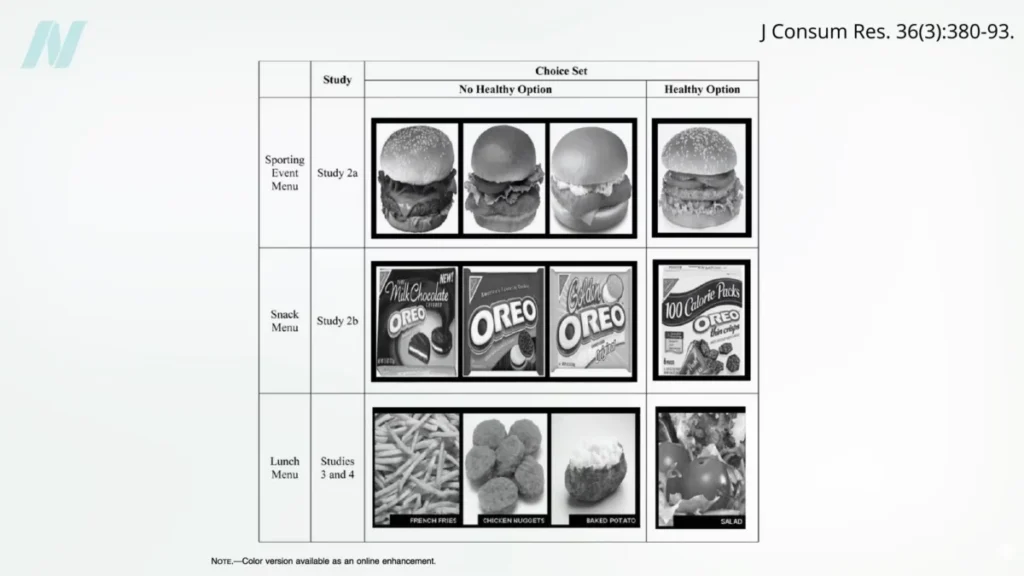
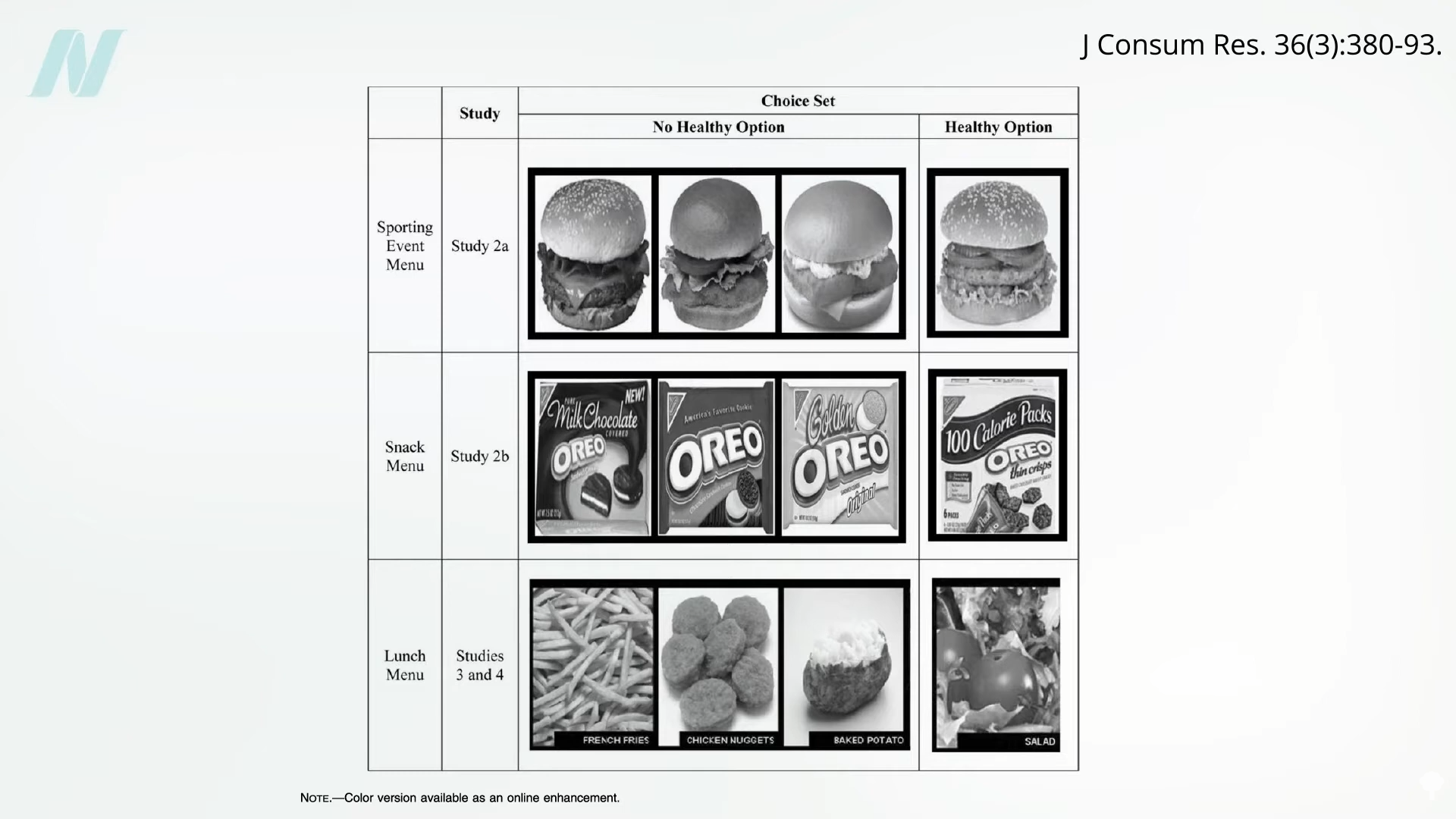
A compelling experiment illustrates this vividly. When presented with a choice between an unhealthy side dish (French fries) and a more neutral option (a baked potato), only about 10% of participants opted for the fries. However, when an even healthier third option—a side salad—was introduced, the preference for French fries didn’t decrease; instead, it shockingly tripled to 33%. The mere visual presence of the salad, offering a virtuous alternative, inexplicably pushed a larger segment of consumers towards the most indulgent choice.

This pattern is not isolated to side dishes. A similar experiment involving main courses presented participants with a bacon cheeseburger, a chicken sandwich, or a fish sandwich. In this "No Healthy Option" scenario, 17% chose the cheeseburger. When the fish sandwich was replaced with a veggie burger, creating a clear "healthy option," the preference for the bacon cheeseburger dramatically doubled to 37%. The irony is profound: the introduction of a supposedly beneficial choice led to a significant increase in the consumption of the least healthy alternative.
Self-Licensing: The Indulgence Justification
The concept of "self-licensing" further illuminates this cognitive bias. Self-licensing describes a fascinating glitch in human psychology where individuals unwittingly justify engaging in behaviors that move them away from their long-term goals, immediately after performing actions that align with those goals. It’s akin to rewarding oneself with an indulgence that undermines previous progress. For instance, someone might rationalize eating a donut because they successfully lost weight last week, or skip a workout because they ate a healthy breakfast.
This effect extends beyond food. Smokers who were given "vitamin C" supplements (unknowingly placebos) subsequently smoked nearly twice as many cigarettes as those who believed they were taking "placebo" pills. The perceived act of doing something "good" for their health provided a subconscious license to "live a little," potentially leading to a shorter lifespan rather than a longer one.
The implications ripple into other lifestyle choices as well. Participants given placebo pills, believing them to be dietary supplements, not only expressed less desire to exercise but also followed through by walking approximately a third less. Compared to a control group, these misled individuals were also more likely to choose a buffet over a "healthy, organic meal." A seminal study aptly titled "The Liberating Effect of Weight Loss Supplements on Dietary Control" further confirmed this. Participants randomized to take a purported weight-loss supplement (again, a placebo) were later covertly observed at a buffet. Not only did the "supplement" group consume more food overall, but they also gravitated towards less healthy items. They ate roughly 30% more candy in a "taste test" and ordered more sugary drinks. The investigators concluded that "people who rely on dietary supplements for health protection may pay a hidden price: the curse of licensed self-indulgence."
The "What the Hell Effect": Spiraling Indulgence
The studies on vicarious goal fulfillment revealed that merely contemplating progress towards a goal, not just actual progress, can trigger this licensing effect. Crucially, participants often didn’t just choose a less healthy option; they frequently opted for the unhealthiest available choice. One might assume that the presence of a healthier alternative would at least encourage a middle-ground selection, but the opposite occurred.
This phenomenon is compounded by what psychologists indelicately term the "what the hell effect." This describes a common pattern among dieters where a single deviation from their eating plan (e.g., one forbidden cookie) can lead to a complete abandonment of restraint and the consumption of an entire bag. Once the psychological boundary has been crossed, the reasoning becomes: "I’ve already strayed, so why not go all the way?"
This effect was demonstrated in an Oreo experiment. In a "No Healthy Option" scenario featuring chocolate-covered Oreos, regular Oreos, or golden Oreos, researchers found that introducing a "lower-calorie" Oreo option surprisingly doubled the likelihood that study participants would bypass all other choices and go straight for the most indulgent chocolate-covered variety. The initial mental justification of "I’ll choose the healthy option next time" or "I’ve acknowledged the healthy choice" quickly devolves into "what the hell, I’ll indulge fully now."
The Health Halo Effect: Distorted Perceptions
Beyond explicit choices, the "halo effect" of healthy foods can subtly warp our perceptions of calorie content and overall healthiness. This cognitive bias suggests that when an unhealthy item is presented alongside a healthy one, the unhealthy item is perceived as less detrimental than it truly is.
Consider this striking example: when weight-conscious individuals were shown a burger alone and asked to estimate its calories, the average guess was 734. However, when the exact same burger was presented alongside three celery sticks, the estimated calorie count dropped to 619. Even though most participants knew celery contained calories, the mere juxtaposition of the burger with a healthy vegetable made the burger appear healthier, causing approximately 100 calories to seemingly vanish from their perception. This effect holds true across various combinations: adding an apple to a bacon-and-cheese waffle sandwich, a side salad to beef chili, or carrots next to a cheesesteak consistently diminishes the perceived calorie count of the indulgent item.
This health halo effect can even explain broader ordering patterns. Research has indicated that people are more likely to order a dessert and more sugary drinks when purchasing a "healthier" sub at Subway compared to a Big Mac at McDonald’s. This occurs despite the fact that the "healthy" sub used in the study (filled with ham, salami, and pepperoni) actually contained 50% more calories than the Big Mac it was being compared against. The perception of Subway as a "healthier" fast-food chain, regardless of the specific item ordered, seems to license additional indulgence.
Even a simple textual reference to healthy foods can trigger this distortion. When shown a picture of a Big Mac, people estimated it contained 646 calories. However, by merely adding the text "For your health, eat at least five fruits and vegetables per day" to the same advertisement, the perceived calorie count of the Big Mac plummeted to 503. This illustrates how easily consumer perceptions can be manipulated by subtle cues, allowing fast-food companies to promote salads and fruit, garnering accolades and bolstering consumer loyalty, without actually improving public health.
Policy Intent vs. Psychological Reality: Official Responses and Industry Dynamics
The revelations from these psychological studies paint a sobering picture for public health policy. The intention behind initiatives like calorie labeling—to empower consumers with information for healthier choices—is undeniably noble. Governments and health organizations have genuinely sought to combat the obesity epidemic and related chronic diseases through transparency and education. The official response, therefore, has been one of belief in rational consumer decision-making.
However, the industry’s response, particularly its comparatively easy acceptance of calorie labeling versus its fierce opposition to "traffic light" systems, reveals a strategic understanding, perhaps even unconscious, of these psychological biases. While governments believed they were introducing a powerful tool for consumer empowerment, the food industry likely recognized that calorie labels, without more prominent, evaluative cues, would have minimal impact on their bottom line. Instead, they could leverage the "perception of concern" for consumer well-being, enhancing brand image without significant product reformulation or revenue loss from high-calorie items.
This dynamic highlights a critical disconnect: policymakers often operate under the assumption of a rational consumer, a "homo economicus," who will process information logically and act in their best self-interest. Yet, the reality of human psychology, as illuminated by these studies, is far more complex and often irrational. The official stance of providing information, while seemingly democratic and empowering, fails to account for the deep-seated cognitive biases that can hijack decision-making, leading to outcomes directly contrary to the policy’s aims. The "official response" from the public health sector, while committed to evidence-based interventions, must now grapple with the evidence that some of these interventions are not only ineffective but potentially counterproductive.
Implications for Public Health and Consumer Behavior
The profound implications of these findings extend far beyond the menu board. They challenge the very foundation of many public health campaigns and consumer education strategies that rely on providing information and offering healthier alternatives. If merely seeing a healthy option or being given nutritional data can license greater indulgence, then the efficacy of current approaches must be critically re-evaluated.
For policymakers, these insights demand a shift from simply providing information to understanding and mitigating cognitive biases. Future interventions may need to be more nuanced, perhaps focusing on "nudges" that subtly guide behavior without triggering self-licensing or health halo effects. This could involve default healthy options, strategic placement of items, or reframing choices in ways that don’t inadvertently justify indulgence. For example, instead of offering a salad alongside fries, perhaps making the healthy option the default and requiring an active choice to upgrade to fries could yield better results.
For consumers, awareness of these psychological glitches is the first step towards greater autonomy over their food choices. Understanding that the mere presence of a salad might subconsciously push one towards a larger burger, or that a "diet" drink could lead to an extra dessert, empowers individuals to actively counteract these biases. It underscores the importance of mindful eating and critical thinking, rather than passively relying on external cues or information.
Ultimately, the paradox of choice reveals the intricate and often illogical nature of human decision-making when it comes to health. It highlights that the path to healthier societies is not merely paved with good intentions and readily available information, but requires a sophisticated understanding of the human mind and its fascinating, often self-sabotaging, glitches. The challenge now lies in translating this deeper psychological insight into truly effective strategies that genuinely foster well-being, rather than inadvertently leading us down the path of licensed self-indulgence.