Cool Comfort: A Comprehensive Guide to Selecting the Right Air Conditioner for Your Home
As summer temperatures continue to climb, the importance of reliable, efficient, and quiet air conditioning has moved from a luxury to a necessity for many households. Whether you are battling a heatwave in a high-rise apartment or trying to maintain comfort in a poorly ventilated home office, the market is currently saturated with options ranging from budget-friendly window units to high-tech, battery-operated portable systems.
Selecting the right cooling solution is more than just picking a brand off the shelf; it involves understanding technical specifications like British Thermal Units (BTU) and Combined Energy Efficiency Ratios (CEER). To help you navigate this crowded landscape, we have tested several notable models, analyzing their performance, noise levels, and ease of installation.
The Evolution of the Market: Key Contenders
TCL Q-Series: The Rising Challenger
In the world of consumer electronics, TCL has built its reputation by disrupting the television market with high-value products. They have applied this same philosophy to the HVAC category over the last five years. The TCL Q-Series (10,000 BTU), priced at approximately $369, is a testament to this strategy.
In our testing, we installed this unit in a 120-square-foot bedroom that typically suffers from poor central air circulation. It successfully dropped the temperature by 10 degrees from a sweltering 78°F in three hours. Operating at a steady 60 decibels, the noise level is manageable, and the installation process is straightforward thanks to an intuitive included frame. While it boasts a competitive CEER rating of 15.0—matching industry leaders—it lacks the advanced insulation found in U-shaped models. Furthermore, while the unit supports Matter connectivity, we encountered recurring issues when attempting to sync it with the Apple Home app.
Dreo Portable Air Conditioner 740S
Portable AC units have gained significant traction, not necessarily for their mobility, but for their versatility in installation. The Dreo 740S (10,000 BTU), retailing for $700, is ideal for older buildings where window frame dimensions might be non-standard. Because the unit sits on the floor and only requires a hose bracket in the window, it sidesteps the physical strain of lifting heavy window units.
Featuring dual-hose technology and a smart inverter, the Dreo maintains a respectable 12 CEER rating. During testing in a 150-square-foot office, the cooling effect was nearly instantaneous. Additionally, its evaporative cooling technology eliminates the need for manual water drainage, a significant convenience for daily use.
Budget-Friendly Reliability: GE AWAS05BBA
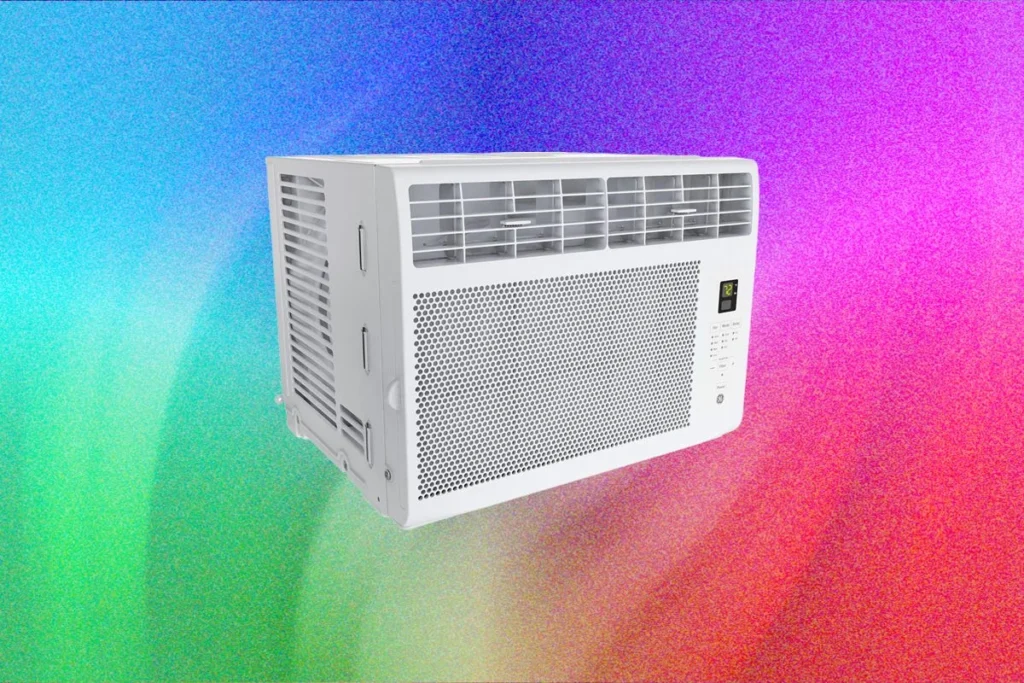
For those seeking a straightforward, no-frills cooling solution, the GE AWAS05BBA (5,000 BTU) at $231 remains a top contender. It is a minimalist machine: no app, no remote, and limited airflow direction (left-right only). However, it excels in its primary function, cooling small 150-square-foot spaces efficiently and with surprisingly low noise. It is the most affordable unit we tested, making it an excellent choice for budget-conscious consumers who prioritize function over smart-home integration.
The Large-Room Performer: LG 12,000 BTU
The LG 12,000 BTU Smart Window Air Conditioner ($379) serves as a powerhouse for larger rooms. Weighing in at 90 pounds, this unit is a heavy lifter that requires professional installation or at least a very sturdy support bracket. While its smart app proved to be laggy during our testing, the physical unit is a solid performer. Its design is unobtrusive, and the filter replacement indicator is a thoughtful touch for maintenance-heavy users.
Advanced Cooling: The High-End and Portable Landscape
Friedrich Kuhl: The Premium Choice
At $1,228, the Friedrich Kuhl is an investment-grade unit. Its weight and price reflect its robust construction, featuring a heavy-duty metal chassis designed to deter break-ins and facilitate long-term maintenance. Beyond its cooling power, it offers superior air quality control through compatibility with the Friedrich FreshAire MERV 13 filter. While the smart-home app is somewhat restrictive—pairing only with 2.4 GHz signals—the unit offers a level of durability and air filtration that few competitors can match.
The EcoFlow and Zero Breeze Factor
The portable AC category has been revolutionized by units designed for both indoor and outdoor use. The EcoFlow Wave 2 ($1,299) represents a major leap forward from its predecessor. With a 5,100 BTU cooling capacity and a 6,100 BTU heating mode, it is a year-round climate control solution for small rooms. Its true innovation, however, lies in its modular power system, allowing users to connect external batteries or solar panels for off-grid operation.

Conversely, the Zero Breeze Mark II and III focus on extreme portability. The Mark III ($1,399) is designed for enthusiasts who require cooling in remote settings. With a 5,280 BTU output and stackable battery packs, it provides freedom from the wall outlet, though the price point is steep and the expansion batteries add significant cost.
Chronology of Testing and Industry Trends
Over the past decade, the HVAC industry has shifted heavily toward "Inverter" technology. Unlike older "on-off" compressors that cycle at full power, inverter-driven units adjust their speed to maintain a target temperature, resulting in significantly higher efficiency and lower noise. Our recent testing confirms that units released within the last 24 months, such as the TCL Q-Series and the Dreo 740S, consistently outperform older models in terms of electricity consumption and acoustic output.
Supporting Data: Understanding Efficiency
When evaluating these units, the Combined Energy Efficiency Ratio (CEER) is the gold standard. A higher CEER indicates a more efficient machine.
- Budget Tier: 9.0–10.5 CEER
- Mid-Range: 11.0–13.0 CEER
- High-Efficiency/Inverter: 14.0+ CEER
Data from the US Department of Energy suggests that upgrading from an older, low-efficiency window unit to an Energy Star-certified model with a CEER of 14+ can reduce cooling costs by up to 25% annually.
Official Guidelines and Best Practices
What Size AC Do You Need?
The most common mistake consumers make is "over-sizing." A unit that is too powerful will cool a room too quickly, failing to remove the humidity from the air. This leads to a cold, clammy room and creates a breeding ground for mold.
- Rule of Thumb: 20 BTUs per square foot of space.
- Calculation: Multiply room length by width. For a 150-square-foot room, 5,000 BTU is generally the sweet spot.
Installation Safety
Regardless of the model, safety must be the priority. In urban environments, many municipalities now mandate the use of support brackets. Always ensure the unit is tilted slightly outward (per manufacturer instructions) to allow condensation to drain properly, preventing water buildup and potential damage to your windowsill or the internal components of the AC.
Implications for the Modern Consumer
The current market reflects a divergence in consumer needs. On one end, we see a demand for "Smart Home" integration, where users want to control their climate via voice assistants or mobile apps. However, as noted in our testing of the TCL and LG models, software stability remains a "work in progress" for many traditional appliance manufacturers.
On the other end, the rise of battery-powered portable units like the EcoFlow and Zero Breeze signifies a cultural shift toward "climate independence." Whether for emergency preparedness or camping, consumers are increasingly viewing air conditioning as a mobile utility rather than a permanent fixture.
Ultimately, whether you choose the budget-friendly GE or the high-end Friedrich, the best air conditioner is the one that is properly sized for your space and installed with professional-grade safety in mind. As efficiency standards continue to rise and inverter technology becomes the baseline, the consumer wins through lower energy bills and a more comfortable home environment.