The Bitter Harvest: How Climate Change is Rewriting the Future of Wine
By Kathleen Willcox
Updated: August 20, 2026
Toasting to love, success, and the milestones of life with a glass of crisp Champagne or a robust Bordeaux has long been a foundational ritual of human celebration. It is an elevated, sensory exercise that feels as permanent as the landscape itself. Yet, as we navigate the volatility of 2026, that glass of wine is beginning to feel like a relic of a bygone era—a luxury as delicate and increasingly rare as the act of hand-churning butter in a modern industrial kitchen.
The climate crisis has moved beyond the realm of scientific projection and into the daily operational reality of the global wine industry. For viticulturists, the "new normal" is defined by a chaotic oscillation between scorched earth and frozen vine, leaving winemakers scrambling to preserve the soul of their craft against an environment that has turned hostile.
The Anatomy of an Existential Crisis: Main Facts
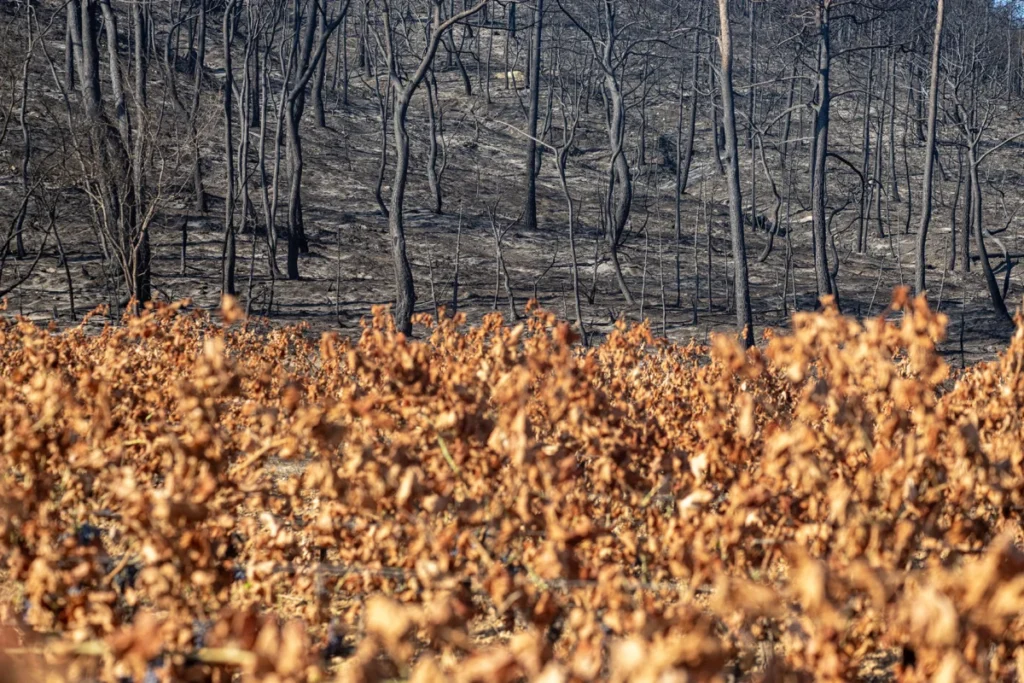
The wine industry is currently facing a "triple threat" of climate-induced disasters: fire, ice, and drought. The summer of 2026 has been particularly brutal for the Old World. In France and Spain, massive swathes of historic wine country have been reduced to ash. Hundreds of thousands of acres—land that has produced world-class vintages for centuries—have been incinerated, leading to the mass evacuation of residents and the total loss of seasonal harvests.
However, heat is only one side of the coin. The industry is trapped in a paradox: as global temperatures rise, the unpredictability of weather patterns has led to devastating "late-spring" frost events. In 2026 alone, vineyards across the American East Coast and the heart of France reported the loss of up to 90% of their potential harvest due to surprise deep freezes and violent hail storms. When the vines aren’t battling fire or ice, they are contending with prolonged, structural droughts that render traditional irrigation techniques obsolete.
A Chronology of Climate Instability
The transition from "once-in-a-century" weather events to annual nightmares has occurred with alarming speed.
- The 20th Century Context: Historically, viticulture was a profession governed by "vintage variation," where a cool year or a wet year was simply a stylistic challenge. The climate was relatively predictable, allowing for established regional identities to flourish.
- The Acceleration (2010–2020): Scientists began tracking a clear shift in phenology—the timing of biological events. Harvests began creeping forward, with growers noting that grapes were reaching sugar maturity weeks earlier than in previous decades.
- The Current Threshold (2025–2026): Recent data from Environmental Research Letters indicates a tipping point. Researchers warn that without radical intervention, luxury crops—including wine grapes, coffee, and chocolate—face extinction in their traditional strongholds by as early as 2036.
Jean-François Ott, the fourth-generation winemaker at the legendary Domaines Ott in Provence, notes the stark shift in his own lifetime. "When I was a child, the harvest began two to three weeks after school started," Ott recalls. "Today, my children are starting school and we have almost finished the harvest. We’ve lost more than a month in 40 years."
Supporting Data: The Warping of Growth Cycles
The vine’s biological clock is out of sync with the calendar. A vine’s life cycle is governed by solar radiation, temperature, and water availability. Historically, the period between flowering and harvest was roughly 100 days. Today, that window has shrunk to 80 days—a 20% reduction that fundamentally alters the chemistry of the grape.

Dr. Ariel Morrison, a lead researcher on luxury crops at Colorado State University, points to the potential use of geoengineering, such as Stratospheric Aerosol Injection (SAI), to mitigate these effects. SAI involves injecting sulfur dioxide particles 70,000 feet into the atmosphere to create a reflective "haze" that cools the Earth.
However, Dr. Morrison’s simulations for the 2036–2045 period suggest that while cooling the planet is theoretically possible, the redistribution of rainfall and humidity caused by SAI would render it ineffective for 12 of the 18 major wine regions studied. "Grapes will likely still grow where they are currently planted," Dr. Morrison notes, "but whether they will thrive and produce high-quality wine is increasingly questionable."
Official Responses and Adaptive Strategies
In the face of this systemic instability, winemakers are moving from a reactive stance to a proactive, experimental one. The consensus is that if the climate won’t adapt to the grapes, the grapes—and the way they are grown—must adapt to the climate.
1. Rethinking Vineyard Orientation
At Gloria Ferrer in Sonoma, California, vineyard director Brad Kurtz is leading a massive replanting project. "We want to be prepared for everything," Kurtz says. The team is fundamentally changing the row orientation of their vines to protect fruit from the harsh afternoon sun—a direct response to rising instances of "sunburned" Pinot Noir. This orientation also aligns with prevailing winds, which helps dry out vines after rain, significantly reducing the risk of fungal disease.

2. Experimental Architecture
Adam Casto, head winemaker at Ehlers Estate in Napa, is currently overseeing one of the earliest harvests in his career. He is experimenting with "vine architecture," adjusting fruit height and canopy distribution to create a micro-climate of shade for the grapes. Furthermore, Ehlers Estate has planted pilot blocks of heat-tolerant, non-traditional varieties like Marselan and Arinarora, effectively "future-proofing" their estate with grapes better suited for a warming world.
3. Diversity as an Insurance Policy
In Rías Baixas, Spain, Emilio Rodríguez Canas of Terras Gauda is championing the Caiño Blanco grape. Because it has a longer growing cycle than the region’s staple Albariño, it ripens later in the year, during cooler days. This preserves the acidity and structural integrity of the wine, preventing the flabby, over-ripe profiles that often plague grapes harvested during intense summer heatwaves.
Alejandro Vigil, winemaking director at Catena Zapata in Mendoza, Argentina, echoes this philosophy of diversification. "Rather than relying on one solution, we match each variety and farming practice to the specific environment," he explains. His use of "massal selection"—planting a variety of genotypes within a single vineyard—creates a genetic insurance policy, ensuring that at least some vines will survive regardless of the specific stresses of a given vintage.
Global Implications: The High-Elevation Frontier
As the lowlands become increasingly volatile, the industry is looking upward. Every 100-meter increase in elevation yields a drop in temperature of approximately 0.65 to 1 degree Celsius. By moving vineyards to higher altitudes, winemakers can replicate the cooler climates of the past.

However, there are physical and biological limits to this migration. Grapes require a specific intensity of sunlight for photosynthesis and the development of the polyphenols that give wine its color, tannin, and complexity. Furthermore, the economic reality is harsh: the cost of moving an entire vineyard operation to a mountain slope is prohibitive for all but the most well-funded producers.
Conclusion: A Future Requiring Commitment
The threat is clear: the "vandalism" of climate change—from wildfires in Provence to frost death in Germany—is challenging the very existence of viticulture as a high-quality agricultural pursuit. While grapes are hardy, the refined, delicate, and expressive wines that define global culture are fragile.
The path forward requires a blend of ancient wisdom—such as selecting indigenous, long-cycle grapes—and cutting-edge technological intervention. But as Dr. Morrison and winemakers like Jean-François Ott suggest, technical hacks are merely stopgaps. Without a global commitment to curbing greenhouse gas emissions and a fundamental shift in how we manage land, the "toast" of the future may be a different drink entirely. The wine industry is effectively in a race against time, and for many, the time to act is not tomorrow—it was yesterday.