The Rise of the Velo-Vineyard: Why Cyclists are Flocking to the World’s Finest Wine Regions
By Lydia Price
September 25, 2026
There is an undeniable, symbiotic relationship between the act of cycling and the appreciation of fine wine. Both pursuits require a deep connection to the land, an appreciation for terroir, and a willingness to engage with the rhythm of the environment. As travelers increasingly seek out "slow travel" experiences that prioritize physical immersion over passive sightseeing, the intersection of cycling and oenotourism has shifted from a niche hobby to a global travel phenomenon.
From the sun-drenched, white limestone slopes of Provence to the rugged, schist-cut valleys of Portugal, the world’s most prestigious wine regions are being reimagined through the lens of a bicycle seat.

The Convergence of Geography and Gastronomy
The geographic attributes that make for world-class viticulture—draining slopes, varied microclimates, and complex soil compositions—are the very same features that create the world’s most exhilarating cycling terrain. The elevation gain required to produce a robust grape is often the same elevation that provides the panoramic vistas cyclists crave.
"Traveling by bike puts you directly into the landscape," says Katy Rockett, regional director of North America at tour operator Explore Worldwide. "You are riding through vineyards, agricultural areas, and smaller communities that you would simply fly past in a rental car. This creates a much stronger, visceral connection between the wine in your glass and the soil it was birthed from."
This trend is backed by significant market movement. Explore Worldwide has reported a 31% year-over-year increase in bookings for their Porto to Lisbon cycling route, while their Lisbon to Algarve itinerary has seen a staggering 40% surge in demand.

The E-Bike Revolution: Democratizing the Climb
For years, the prospect of combining a grueling mountain ascent with a wine tasting was limited to the most seasoned semi-professional athletes. However, the rapid advancement and proliferation of electric bicycles (e-bikes) have fundamentally altered the landscape of active travel.
"Pairing cycling with wine tourism answers a growing demand for immersive, active experiences," explains Dagmar Lombard, general manager of Hôtel Crillon le Brave in southeastern France. "The rise of the electric bike has made these regions far more accessible. It’s no longer just for the hardcore cyclist; now, guests of all fitness levels can explore the vineyards around us or even take on a legendary challenge like the ascent of Mont Ventoux without fear of total exhaustion."
Global Destinations for the Two-Wheeled Oenophile
The following regions have emerged as the premier global hubs where the love of the road meets the love of the vine.

1. Provence, France: The Cradle of Rosé
Provence is a masterpiece of sensory travel. Cyclists here weave through fragrant lavender fields and ancient Roman roads. The highlight for many is the ascent of Mont Ventoux. Known as the "Giant of Provence," this mountain, a recurring stage in the Tour de France, offers a moon-like limestone summit and sweeping views of the Rhône Valley.
Hôtel Crillon le Brave, a property built into the footprint of a 17th-century village, serves as an ideal basecamp. Holding the Accueil Vélo certification—France’s rigorous standard for cycle-friendly businesses—it provides on-site rentals, secure storage, and post-ride spa treatments. Once the wheels stop spinning, the region’s signature mineral-tinged rosés offer the perfect refreshment.
2. Douro Valley, Portugal: A Test of Grit
For the cyclist who wants a true challenge, the Douro Valley is non-negotiable. As a UNESCO World Heritage site, the region is characterized by steep, terraced vineyards carved into schist-cut slopes. These gradients are unforgiving, but the rewards are profound.

The valley is home to the quintas—historic wine estates—that produce world-class Port and increasingly sophisticated dry table wines. Producers like the Symington Family Estates, which manage historic sites such as Quinta do Vesúvio, provide the ultimate incentive: a glass of vintage Port at the end of a grueling, sun-baked climb.
3. Stellenbosch and Franschhoek, South Africa
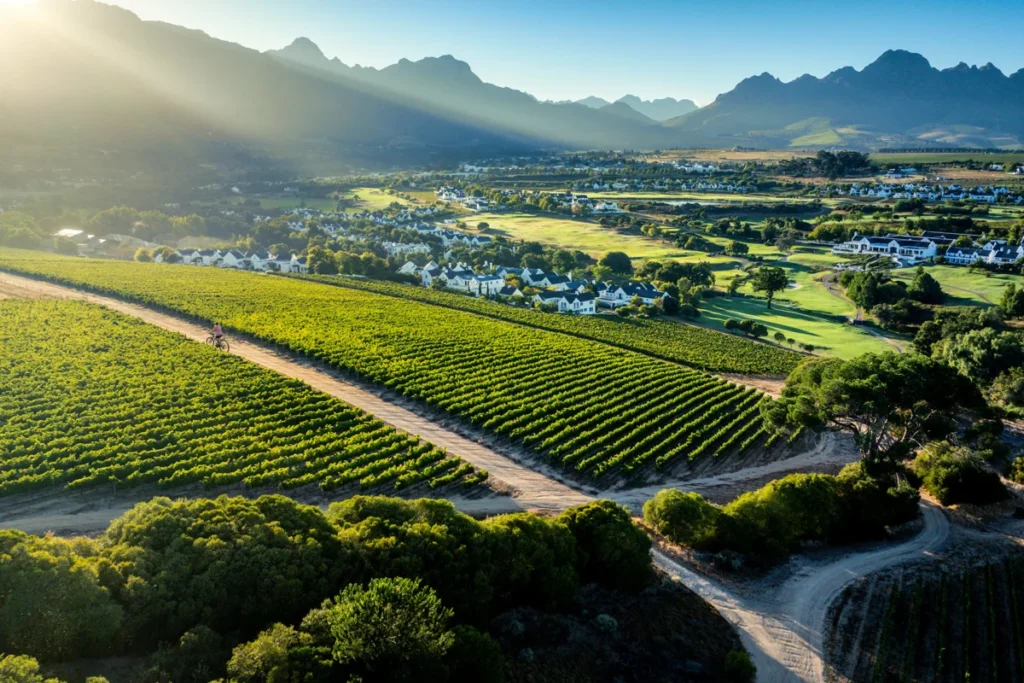
South Africa’s Cape Winelands have cultivated an outdoor-adventure culture that is unmatched in the Southern Hemisphere. In Stellenbosch, the trail options are exhaustive, ranging from manicured road paths to rugged gravel and mountain bike trails.
A popular route takes cyclists over the Helshoogte Pass into the valley of Franschhoek. Here, the pace slows, and the focus shifts to estates like Delaire Graff, which offers luxury suites with private pool terraces. Further along, the historic Boekenhoutskool winery provides a masterclass in Cabernet Sauvignon and Syrah, set against a backdrop of dramatic mountain peaks.

4. Sonoma Valley, United States
While Napa Valley often claims the headlines, Sonoma offers a more expansive, bike-friendly topography. With 19 distinct AVAs, Sonoma provides a diverse landscape of redwood forests, coastal trails, and quiet valleys.
The Healdsburg and Dry Creek Valley areas are particularly welcoming. West Dry Creek Road, a 10-mile stretch, serves as a quintessential ride, passing over a dozen boutique wineries. A stop at Lambert Bridge for a curated picnic basket in their private gardens is considered a rite of passage for Sonoma cyclists.
5. Loire Valley, France: The Epicurean Route
The La Loire à Vélo trail is perhaps the most famous long-distance cycle route in the world. Spanning 560 miles from Burgundy to the Atlantic, it traverses Renaissance châteaux and riverside villages. For a more volcanic twist, the Via Allier leads into the Côtes d’Auvergne, where cyclists can sample wines from producers like Desprat Saint Verny, exploring a viticultural history that stretches back to the Romans.

6. Barossa Valley, Australia
The Barossa Trail is a 25-mile, sealed path designed specifically for ease of access. With gentle gradients and frequent water stations, it is perfect for those who prioritize the tasting over the perspiration. The detour via the Gomersal Trail leads to the iconic Seppeltsfield Wines, where the historic, palm-lined entrance creates an atmosphere of timeless grandeur.
7. Girona and the Empordà, Spain
Girona has long been the training ground for professional cyclists, but its proximity to the DO Empordà wine region makes it a dual-purpose paradise. Riders can navigate through ancient cork forests and medieval villages before stopping for a glass of Garnatxa Negra. The Pirinexus loop offers some of the most dramatic gravel terrain in Europe, with routes stretching from the Mediterranean coastline to the foothills of the Pyrenees.
8. Willamette Valley, United States
Oregon’s Willamette Valley Scenic Bikeway was the first of its kind in the nation. Covering 134 miles, the route connects the Coast and Cascade ranges, winding past hazelnut orchards and hop fields. The proximity to Pinot Noir producers like Ankeny Vineyard—where wood-fired pizza and a cool-climate Chardonnay await—makes it a top-tier destination for a multi-day tour.

9. Tuscany, Italy: The Spiritual Home of Cycling
Cycling is deeply embedded in the Tuscan psyche. With over 9,000 miles of routes, the region offers everything from the peaceful, white gravel paths of the Via Francigena to the punishing ascents of the Garfagnana mountains. Whether one is traversing the Chianti Classico region or exploring the hilltop towns of Montalcino, the ability to pair a morning ride with an afternoon of world-class Sangiovese makes Tuscany the pinnacle of the cycling-oenotourism experience.
Implications for the Future of Travel
The rise of "velo-oenotourism" is not merely a trend; it is a fundamental shift in how luxury travelers choose to engage with their surroundings. As the infrastructure for cycling continues to improve—supported by government investment in bike paths and the hospitality industry’s push for cycle-certified accommodations—the barrier to entry will continue to drop.
For wineries, this shift represents a new demographic of customer: one who is health-conscious, environmentally aware, and seeking a story to attach to their bottle of wine. By aligning their estates with the needs of the modern cyclist—secure bike storage, hydration stations, and healthy post-ride food pairings—these regions are ensuring that their heritage remains relevant to a new generation of travelers.

The message is clear: if you want to understand the wine, you must first understand the land. And there is no better way to understand the land than to traverse it on two wheels, one pedal stroke at a time.