Financial Planning in the Millennial Era: A Comprehensive Analysis of Debt Management and Path to Homeownership

Main Facts: The Paradox of High Income and Financial Insecurity

In an era defined by volatile housing markets and the rising cost of living, even high-earning professionals find themselves grappling with the complexities of debt and delayed milestones. A recent financial case study of a Connecticut couple, Brian and Michael, both 34, highlights a growing trend among millennials: the "high-income, low-net-worth" trap. Despite a combined gross household income of approximately $167,544, the couple reports significant psychological and financial strain due to a $28,259 consumer debt load and a lack of real estate equity.
Michael, a project coordinator for a state behavioral health agency and a disability leadership advocate, and Brian, a quality assurance manager for a state-run hospital, represent a demographic that is technically successful but feels "behind" their peers. Their financial profile is a study in contrasts. They possess robust state-sponsored retirement benefits, including a pension and access to specialized 457b and 403b accounts, yet they maintain less than $10,000 in liquid emergency savings—a sum that covers barely one month of their $8,035 monthly expenditures.

The couple’s primary objectives include achieving permanent debt freedom, transitioning from luxury rental living to homeownership, and evaluating the long-term viability of further education and business ventures. Their situation underscores the necessity of moving beyond "survival budgeting" toward a structured, strategic allocation of capital.
Chronology: From Debt Clearance to the 2023 Rental Crisis

The couple’s financial journey over the last decade has been marked by significant triumphs followed by recent setbacks. Since beginning their relationship in 2013, they have navigated several major life transitions:
- The Student Loan Milestone: Several years ago, Brian successfully paid off $58,000 in student loans, a feat that should have provided a springboard for wealth accumulation. This period was marked by career shifts for Brian, moving from the private non-profit sector to a stable, well-compensated state government role.
- The Studio Apartment Era: For eight years, the couple lived in a 600-square-foot studio apartment with a modest rent of $945 per month. This low overhead allowed for a degree of financial flexibility that was eventually disrupted by external factors.
- The 2022-2023 Displacement: The stability of their living situation ended abruptly when they were forced to navigate a hyper-competitive rental market. Over a period of three and a half months, the couple scrambled to find a new residence while simultaneously managing unexpected veterinary expenses for two new kittens with medical complications.
- The Transition to Luxury Rental: The couple eventually settled into a refurbished industrial mill in central Connecticut. While the apartment offers significant lifestyle improvements—including 12-foot ceilings and dedicated office space—it came with a rent increase of over 100%, rising to $2,000 per month.
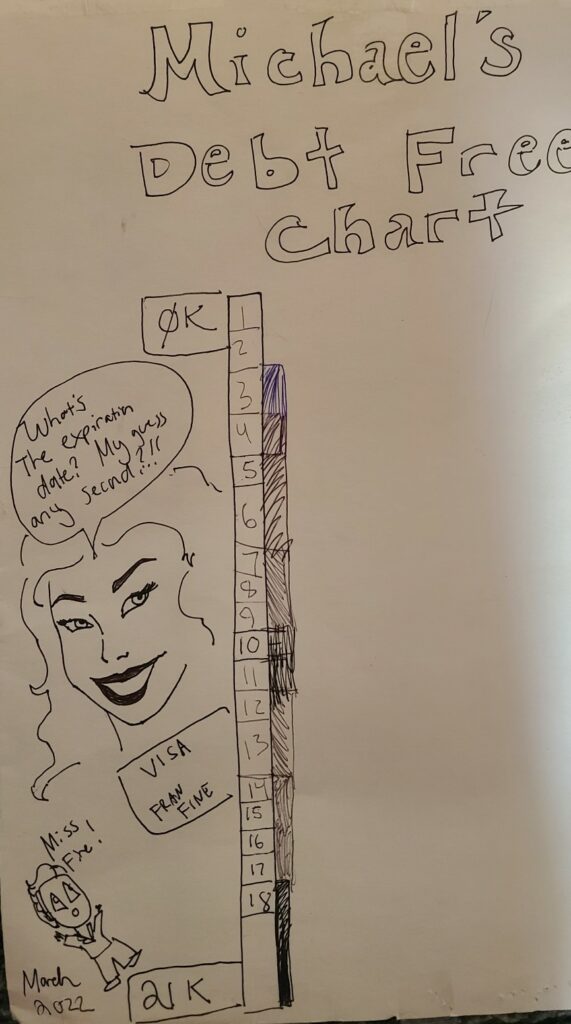
- The Accumulation of Consumer Debt: The costs associated with moving, combined with veterinary bills and high discretionary spending, led to the accumulation of over $28,000 in credit card debt. With promotional 0% interest rates set to expire in November 2023, the couple now faces a "fiscal cliff" where interest rates could spike to nearly 18%.
Supporting Data: An Audit of Income, Expenses, and Liabilities

A granular look at the couple’s balance sheet reveals the mechanics of their financial "famine and feast" cycle.
Income Streams:
The household’s net annual income is $109,455.42, derived from three primary sources:
- Brian’s State Salary: $2,344.36 net bi-weekly.
- Michael’s Primary Role: $1,066.00 net bi-weekly.
- Michael’s Secondary Advocacy Role: $703.61 net bi-weekly.
- Supplemental Income: Approximately $2,500 annually from consulting and seasonal tax support.
The Debt Matrix:
The couple’s $28,259 debt is distributed across three high-limit credit cards:
- SCU Visa (Brian): $16,057 (0% interest until Nov 2023; 17.99% thereafter).
- Navy Federal Visa (Michael): $9,700 (10.99% interest).
- Navy Federal Visa (Brian): $2,503 (0.99% interest until Nov 2023; 17.74% thereafter).
Monthly Expenditure Analysis:
The couple’s current monthly outgoings total $8,035. While $2,000 of this is directed toward debt repayment, other significant costs include:

- Transportation: $1,064 (averaging Brian’s recent major car repairs and commuting costs).
- Pet Care: $517 (driven by prescription food and veterinary follow-ups).
- Discretionary Spending: Over $1,000 is allocated to dining out, gifts, home goods, personal care, and media.
The data suggests that while the couple has a surplus of approximately $13,000 annually (net income minus expenses), this margin is too thin to build a down payment for a home while simultaneously servicing debt and maintaining an aging fleet of vehicles (a 2007 Mercedes and a 2007 Subaru, both with 175,000 miles).
Official Responses: Expert Recommendations for Financial Rehabilitation

Financial expert Liz Frugalwoods provided a comprehensive framework for Brian and Michael to stabilize their trajectory. Her analysis shifts the focus from "shame-based" thinking to "spreadsheet-based" problem-solving.
1. Immediate Expense Tracking and "Spending Detox"
The primary recommendation is the implementation of a rigorous expense tracking system. The expert argues that until every dollar is accounted for, the couple cannot effectively prioritize. She suggests a "spending detox"—a temporary but total elimination of discretionary spending. By reclassifying expenses into "Fixed," "Reduceable," and "Discretionary," the expert identified a potential $1,370 in monthly savings.

2. Aggressive Debt Amortization
The expert advises prioritizing debt repayment over all other goals, including homeownership savings. By combining their existing $2,000 monthly debt payment with the $1,370 saved from a spending detox, the couple could apply $3,370 per month toward their balances. At this rate, the entire $28,259 debt could be liquidated in approximately six to seven months, narrowly avoiding the 18% interest rate hike scheduled for November.
3. Liquidity and the "Emergency Fund" Buffer
A critical vulnerability identified was the couple’s lack of liquidity. With only $9,000 in cash, they are one major car repair or medical emergency away from further debt. The expert recommends building a three-to-six-month emergency fund ($24,000–$48,000) immediately following debt liquidation. This fund is described as a "safety net" that prevents the "revolving door" of credit card reliance.

4. Strategic Retirement Optimization
Brian’s access to a "Triple Crown" of retirement—a pension, a 403b, and a 457b—is a significant asset. The expert recommends Brian prioritize the 457b account due to its unique provision allowing penalty-free withdrawals after leaving an employer, regardless of age. This offers a bridge to early retirement that a traditional 401k does not.
5. The Graduate School Question
Addressing Brian’s interest in a master’s degree, the expert offered a pragmatic, ROI-focused critique. She advised against pursuing further education unless there is a "guaranteed, iron-clad correlation" to a significant salary increase. In the absence of such a guarantee, the degree is viewed as an "unhelpful detour" from their primary goal of homeownership.

Implications: The Path to Sustainable Wealth
The case of Brian and Michael serves as a blueprint for middle-class financial recovery in a post-pandemic economy. The implications of their journey suggest several broader truths about modern personal finance:

- Income is Not Wealth: A six-figure income provides the capacity for wealth, but without disciplined cash-flow management, it often leads to "lifestyle creep" and increased debt.
- The Psychological Weight of Debt: Both Brian and Michael reported feelings of "shame" and "disappointment." The study suggests that the mental health benefits of debt freedom are as significant as the financial ones.
- Homeownership Readiness: The analysis concludes that homeownership is a "Phase 3" goal. Attempting to purchase property before securing an emergency fund and clearing consumer debt often leads to "house poor" scenarios where the owners cannot afford necessary maintenance.
- The Importance of Public Sector Benefits: Brian’s state employment, though it required encouragement from Michael to pursue, provides a "healthcare for life" and pension safety net that is increasingly rare. This structural stability allows the couple to take more aggressive risks in their debt repayment strategy than those in the private sector might.
In conclusion, Brian and Michael are not in a "dismal" position, but rather a transitional one. By shifting from a consumption-based lifestyle to a priority-based one, they are positioned to achieve debt freedom by mid-2024, paving the way for a stable, land-owning future in the years to follow.