The Rise of Velo-Tourism: Why Wine Lovers are Trading Cars for Handlebars
By Lydia Price
September 25, 2026
The modern traveler is increasingly rejecting the passive, window-view sightseeing of tour buses in favor of a more visceral connection to the land. This shift has birthed a rapidly expanding niche in the luxury and adventure travel sectors: the intersection of serious cycling and oenology. The geographic conditions that produce world-class vintages—dramatic elevation changes, nutrient-rich soil, and temperate microclimates—are the same elements that create the most exhilarating cycling routes.

For the contemporary enthusiast, the goal is no longer just to taste a bottle, but to earn it through physical exertion. As global demand for immersive, active vacations surges, the world’s most prestigious wine regions are recalibrating their infrastructure to cater to the two-wheeled visitor.
The Data Behind the Trend: A Surge in Active Travel
The convergence of cycling and wine tourism is not merely anecdotal; it is backed by significant industry growth. Tour operators specializing in active travel are reporting double-digit increases in bookings for regions that offer integrated cycling-and-wine itineraries.

“Our Porto to Lisbon cycling trip has seen bookings increase 31% year-over-year, while our Lisbon to Algarve trip is also seeing growth, with bookings up 40%,” explains Katy Rockett, regional director of North America at the tour operator Explore Worldwide. “Traveling by bike puts you directly into the landscape, riding through vineyards, agricultural areas, villages, and smaller communities. There is a much stronger connection between the wine you’re tasting and the place it comes from.”
This sentiment is echoed by industry leaders on the ground. Dagmar Lombard, general manager of Hôtel Crillon le Brave in southeastern France, notes that the evolution of technology has acted as a catalyst for this movement. “Pairing cycling with wine tourism answers a growing demand for immersive, active experiences,” Lombard says. “The rise of the electric bike has made it far more accessible—both for exploring the vineyards around us and for taking on a challenge like the ascent of Mont Ventoux.”

Chronology of a Movement: From Rural Transit to Elite Sport
Historically, the bicycle was the primary mode of transport for vineyard workers in Europe. Over the last century, as viticulture became modernized and globalized, the bicycle remained a humble tool of the trade. However, in the early 21st century, the rise of “bicycle tourism” in Europe—led by organizations like EuroVelo—began to map long-distance routes that happened to intersect with historic wine regions.
By 2015, the "active recovery" trend in luxury travel began to gain traction. Travelers, particularly those aged 35–60, began seeking vacations that balanced the indulgence of wine culture with the health benefits of cardiovascular exercise. The introduction of high-performance e-bikes around 2020 further democratized these regions, allowing amateur cyclists to tackle the steep grades of the Douro Valley or the Tuscan hills that were previously reserved for professional athletes.

Nine World-Class Destinations for the Cycling Oenophile
1. Provence, France: Lavender, Limestone, and Legend
Provence remains the gold standard for this niche. The region offers a mix of grueling climbs and bucolic paths. Mount Ventoux, a recurring feature of the Tour de France, serves as the ultimate test for serious cyclists, offering a stark, lunar-like limestone summit. For those seeking a slower pace, the region offers serene rides through lavender fields and ancient Roman roads. Properties like Hôtel Crillon le Brave have pioneered "cycle-friendly" hospitality, providing secure storage, rental deliveries, and post-ride spa treatments to earn the Accueil Vélo certification.
2. Douro Valley, Portugal: The Steepest Rewards
The Douro Valley is a UNESCO World Heritage site defined by its punishing terrain. Vines here cling to schist-cut slopes, and the roads are notoriously steep. However, the reward for the climb is access to some of the world’s most historic quintas. Symington Family Estates, which oversees storied properties like Quinta do Vesúvio, provides a fitting end to a day of physical struggle with vintage Ports and increasingly celebrated dry table wines.

3. Stellenbosch and Franschhoek, South Africa
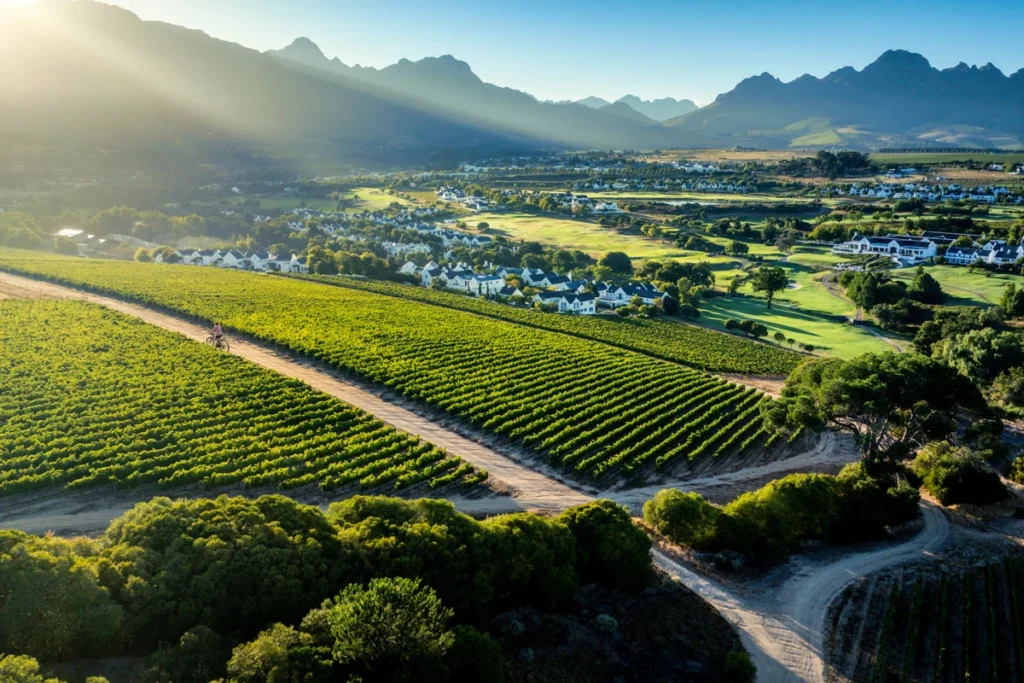
The Cape Winelands offer a diverse array of trails, from gravel paths to mountain bike circuits. The Helshoogte Pass remains a favorite for road cyclists, connecting the university town of Stellenbosch to the culinary heart of Franschhoek. Luxury estates like Delaire Graff serve as high-end basecamps, allowing cyclists to transition from a sweaty morning on the trails to a glass of world-class Cabernet Sauvignon on a private terrace overlooking the Simonsberg Mountains.
4. Sonoma Valley, United States
Sonoma is significantly larger than its neighbor, Napa, and offers a more extensive network of bike-friendly roads. With 19 distinct American Viticultural Areas (AVAs), the region provides endless variety. A popular route is the 10-mile West Dry Creek Road, where cyclists can stop at Lambert Bridge for a curated picnic of local cheeses and charcuterie.

5. Loire Valley, France: The Epicurean Spine
The La Loire à Vélo route is a 560-mile masterpiece of infrastructure. For the more adventurous, the Via Allier leads into the volcanic hills of the Côtes d’Auvergne. This area offers a unique intersection of geology and viticulture, where the soil composition provides a distinct mineral profile for the local Gamay and Pinot Noir, pairing perfectly with the rugged beauty of the landscape.
6. Barossa Valley, Australia
The Barossa Trail is a testament to thoughtful planning. This 25-mile, sealed path is designed for convenience, with public water stations and restroom facilities punctuating the route. It is perhaps the most accessible destination for the casual rider, ending at iconic estates like Seppeltsfield, which boasts a history as rich as its legendary 100-point red blends.

7. Girona and the Empordà, Spain
Girona is arguably the global capital for professional cyclists, but its true beauty lies in its proximity to the Empordà wine region. The Pirinexus loop offers 217 miles of gravel and secondary roads. Here, riders traverse cork forests and medieval villages before tasting the region’s signature Garnatxa Negra, with the Mediterranean Sea often visible in the distance.
8. Willamette Valley, United States
Oregon’s Willamette Valley Scenic Bikeway is the nation’s first official route of its kind. Covering 134 miles, the path winds between the Coast and Cascade ranges. It is a quintessential Pacific Northwest experience, passing hop fields, hazelnut orchards, and the fertile rows of Pinot Noir vines that have put Oregon on the global map.

9. Tuscany, Italy: The Spiritual Home of the Ride
Tuscany’s 9,000-plus miles of cycling routes range from the gentle paths of the Via Francigena to the legendary white gravel roads (strade bianche) that define the region’s cycling culture. It is arguably the best region in the world to pair a morning ride with an afternoon of Sangiovese.
Implications for the Future of Travel
The rise of "velo-tourism" has significant implications for local economies. Wine regions that invest in cycling infrastructure—such as protected bike lanes, signage, and cycle-friendly hotel policies—are seeing a higher retention of "high-net-worth" travelers who stay longer and spend more than the average wine tourist.

However, this growth also presents challenges. The increased volume of cyclists on rural roads requires careful urban planning to ensure safety and prevent friction with local agricultural traffic. Furthermore, the environmental impact of this trend is largely positive; it promotes low-carbon travel and encourages the preservation of rural landscapes.
As we look toward the future, the integration of cycling and wine appears to be more than a passing trend. It is a fundamental shift in how we perceive the "luxury" of a vacation. In an age of digital distraction, the ability to physically traverse the soil that produces one’s favorite vintage provides a level of engagement that no tour bus can replicate. For the modern traveler, the best wine is the one that has been earned by the sweat of the brow and the turn of the pedal.