The High-Altitude Alchemy: Peru’s Radical Reimagining of the Humble Tuber
By Joey Skladany
For the culinary traveler, the potato is the ultimate universal constant. From the salt-crusted skins of a backyard barbecue to the velvety, butter-laden purées of fine dining, the potato is a canvas for comfort. My own devotion to the tuber is well-documented; I have never met a potato I didn’t like. It was this lifelong affinity that led me to Peru, a nation that serves as the biological cradle of the potato. With over 4,000 native varieties—ranging from the knobby and neon-hued to the dark, earth-toned staples of the Andes—Peru offers a masterclass in root-vegetable versatility.
I arrived in the Andes expecting to feast on papa a la huancaína—taters bathed in a fiery, creamy ají amarillo sauce—and perhaps indulge in the structural perfection of papa rellena. What I did not expect was to encounter the potato in a glass, fermented into a complex, nuanced elixir that defies traditional viticultural definitions. This is the story of Peru’s burgeoning "potato wine" movement: an unconventional, high-stakes experiment in ancestral preservation and modern fermentation.
The Genesis of an Andean Oddity
My introduction to this phenomenon occurred at the Sumaq Hotel, a sanctuary of luxury perched at the edge of the Urubamba River in the shadow of Machu Picchu. The hotel’s restaurant, Qunuq—the name itself a nod to the Quechua word for "warm"—is a temple to regional sourcing. Here, the menu traverses the extremes of Andean geography, featuring everything from carpaccio-style alpaca meat to vegetables slow-roasted in a pachamanca, an underground earthen pit that utilizes heated stones to impart a deep, smoky resonance.
During the hotel’s "Flavors of the Andes" tasting menu, the beverage pairing took a turn that commanded my immediate attention. The glass before me held a pale, slightly cloudy liquid. It bore no visual resemblance to a Chardonnay or a Pinot Grigio. On the palate, it was transformative: a creamy, substantive mouthfeel that leaned closer to a premium sake or a clean, rounded vodka. The flavor profile was an intricate tapestry of nuttiness, mild sweetness, and a haunting, herbaceous earthiness.
"Rather than being a traditional wine, it is a modern interpretation of ancient Andean ingredients," explains Omar Saravia, the food and beverage director at Sumaq Hotel. "Throughout the Andes, native potatoes and tubers have been valued for centuries. Today, some producers are taking these ingredients to a new level through innovative artisanal fermentation techniques."

From Ground to Glass: The Work of Manuel Choqque
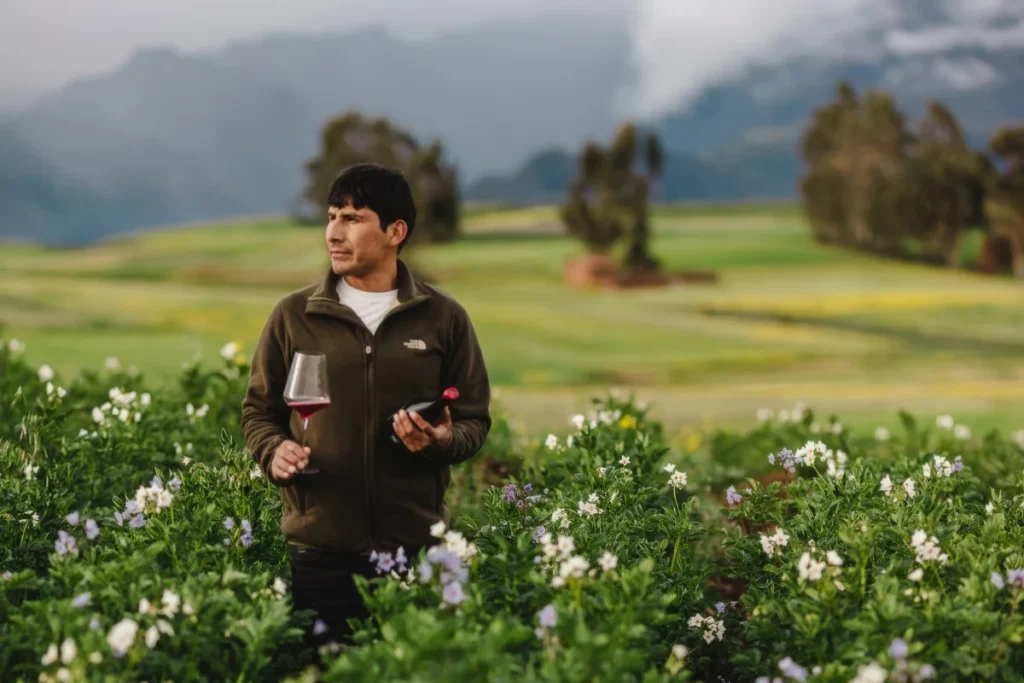
To understand this liquid evolution, one must look to the work of Manuel Choqque. A farmer, chef, and agronomist engineer, Choqque is the visionary behind this movement. In the mid-2010s, he sought a way to preserve native tubers that were slipping into obscurity—varieties that were losing their place in the modern agricultural market.
Most potatoes are notoriously low in the natural sugars required for effective fermentation. Choqque’s breakthrough came when he pivoted to Oxalis tuberosa, more commonly known as oca. This colorful, Andean root vegetable possesses a higher sugar content than its cousin, the Solanum tuberosum (common potato), making it a viable candidate for the transformation he envisioned.
The production of these wines occurs in the rural community of Huatata, located in the Cusco region at an altitude of approximately 3,700 meters above sea level. At this elevation, the air is thin, the solar radiation is intense, and the temperature fluctuations are extreme.
The Chronology of Fermentation
The process is less like traditional winemaking and more like a high-altitude sake production:
- Sun-Curing: The tubers are exposed to the Andean sun for a period ranging from 20 to 60 days. This essential step, rooted in sacred Incan traditions, serves to increase the concentration of natural sugars, temper the acidity, and begin the development of delicate, fruity aromatic profiles.
- Preparation: Once cured, the tubers are cleaned and cooked.
- Must Extraction: The cooked tubers are pressed, creating a must that serves as the foundation for the ferment.
- Slow Fermentation: The mixture undergoes a prolonged fermentation process, often lasting three to four months. The extreme, high-elevation climate dictates a slow, steady metabolism for the yeasts, resulting in a more refined, structured final product.
- Maturation: The resulting liquid is aged in conditions that would challenge most European wineries, resulting in a product that varies significantly from one harvest to the next.
Supporting Data: The Economics of Scarcity
The barrier to entry for this beverage is not just culinary, but logistical. The sheer volume of raw material required to produce a single bottle of "wine" highlights why this product will likely remain a boutique, hyper-regional curiosity rather than a global export commodity.
It takes roughly eight to ten kilograms—approximately 17 to 22 pounds—of oca to produce just one liter of the finished beverage. When factoring in the labor-intensive sun-drying, double-cooking, and the multi-month fermentation window, the production costs become prohibitive for large-scale distribution.

"For now, the focus is on quality and on telling the story through tastings and high-end restaurants, rather than on scaling volume," says Saravia. "The priority is to protect the character and origin of the product."
Official Perspectives: The Regulatory and Cultural Landscape
The term "potato wine" is, in the strictest legal sense, a misnomer. Because the beverage does not contain grapes, it often finds itself in a bureaucratic grey area when it comes to international trade.
Producers like Choqque market their creations under labels such as Miskioca (a portmanteau of oca and miski, the Quechuan word for "sweet") and Oxalis. These bottles are categorized globally as "fermented tuber beverages." This classification presents significant hurdles for export; international regulatory bodies are accustomed to taxing and labeling grape-based wine, but they have no established framework for a fermented root vegetable drink.
Furthermore, there is a fundamental "education curve" that international consumers must climb. As Saravia notes, the beverage is currently tailored for the adventurous palate. It is a companion to Andean cuisine, designed to pair with the earthy notes of roasted mushrooms, heirloom corn, and proteins like alpaca and lamb. Its texture and weight are specifically engineered to stand up to the robust, savory profiles of the region’s traditional diet.
Implications for the Future of Andean Gastronomy
The emergence of tuber-based fermentation has profound implications for biodiversity. By creating a high-value market for native varieties of oca and other Andean tubers, Choqque is providing a financial incentive for local farmers to continue cultivating crops that were once abandoned in favor of more "efficient," commercial potato strains.
This is not merely about making a drink; it is about reinforcing a food system. When a farmer knows that a rare, purple-fleshed oca can be turned into a sophisticated, luxury beverage served in the shadow of Machu Picchu, that farmer is more likely to preserve the seeds of that crop for future generations.

The Verdict on the "Potato Wine" Experience
As someone whose own constitution feels 50% starch, my encounter with potato wine felt like a return to the source. It is an honest, unpretentious, yet technically demanding drink. It does not try to imitate a Bordeaux or a Napa Cabernet. Instead, it offers a window into the land itself.
While it is unlikely that we will see potato wine on the shelves of suburban liquor stores in the near future, its presence in Peru is a triumph of innovation. It reminds us that culinary heritage is not a static relic to be kept behind glass; it is a living, breathing entity that can be fermented, aged, and poured into a glass to tell the story of the earth from which it grew.
To those who find themselves in the Cusco region, seek out these fermented elixirs. Approach them with an open mind and a willingness to be surprised. In a world of globalized, homogenized flavors, the potato wine of the Andes is a defiant, delicious reminder of the power of local identity. And to that—the intersection of biodiversity, culture, and the humble, glorious tuber—I raise a glass and say, "Cheers."