Unmasking the Assault on Nutrition Science: Why Corporate Critiques of Observational Studies Miss the Mark
In the intricate landscape of public health, dietary recommendations stand as crucial pillars, guiding individuals towards healthier lives and mitigating the burden of chronic diseases. Yet, these very guidelines frequently face a barrage of criticism, often from corporate entities with vested interests. A common refrain is the questioning of the scientific nutrition literature, particularly the credibility of observational studies. This critique, often framed through the lens of pharmaceutical research standards, sparks a vital debate: how legitimate is this corporate skepticism, and what are its true implications for public health?
The Core of the Debate: Observational Studies vs. Randomized Controlled Trials
At the heart of the contention lies the fundamental difference between research methodologies. Randomized Controlled Trials (RCTs) are widely considered the gold standard for assessing interventions like drugs. By randomly assigning participants to either a treatment group or a placebo group, RCTs effectively minimize bias and can robustly establish cause-and-effect relationships. However, applying this rigorous standard directly to dietary research presents formidable, often insurmountable, challenges.
The Practicalities of Dietary Research:
Unlike a pill that can be standardized and administered in a double-blind fashion, diet is an incredibly complex and deeply personal aspect of human life.
- Time Horizon: Many diet-related diseases, such as certain cancers or cardiovascular conditions, develop over decades. Conducting an RCT that spans 20, 30, or even 50 years, with participants strictly adhering to a prescribed diet, is logistically and financially prohibitive.
- Placebo Impossibility: There’s no such thing as a "placebo food." Participants inevitably know what they are eating, introducing a level of awareness that can influence outcomes and make blinding impossible.
- Adherence Challenges: Maintaining strict adherence to an assigned diet, particularly for years, is incredibly difficult for most individuals, leading to significant dropout rates or deviations that compromise study integrity.
- Ethical Considerations: It would be unethical to randomize participants to diets known or suspected to be harmful for prolonged periods to observe "hard endpoints" like disease onset or death.
Given these constraints, researchers must frequently rely on observational studies. These studies involve tracking large populations over extended periods, meticulously documenting their dietary habits and health outcomes to identify correlations between specific foods or eating patterns and the incidence of diseases. While observational studies cannot definitively prove causation in the same way an RCT can, they are invaluable for generating hypotheses, identifying trends, and providing crucial insights into real-world dietary impacts.
Defending Observational Evidence: Alignment and Nuance
Despite the inherent differences, the assertion that observational studies are inherently unreliable is often overstated. A critical examination of the literature reveals a surprising degree of concordance between observational population studies and randomized trials. When data from these two distinct methodologies are compared, there is, on average, little evidence for significant differences in findings. Studies have shown that the effects observed in both types of research tend to be not only in the same direction but also of the same general magnitude in approximately 90% of the treatments examined.
A notable example often cited by critics is the initial apparent disparity surrounding hormone replacement therapy (HRT). Early observational studies suggested that women taking Premarin experienced fewer heart attacks. However, subsequent randomized controlled trials appeared to show the opposite effect. Further scrutiny of the data, however, revealed that these discrepancies were primarily rooted in timing – specifically, when Premarin was initiated relative to menopause. Once this critical temporal factor was accounted for, the studies ultimately demonstrated consistent results, underscoring the importance of nuanced interpretation rather than outright dismissal of observational findings.
A Spectrum of Evidence: Tailoring Standards to Risk
Beyond the methodological debate, a crucial argument centers on the appropriate level of certainty required for different types of health interventions. It is a fundamental principle that the rigor of evidence should align with the potential risks and benefits of an intervention.
The High Stakes of Pharmaceuticals:
Prescription drugs carry inherent and often substantial risks. Alarmingly, medical research indicates that prescription drugs are a leading cause of death in developed nations, ranking third in both Europe and the United States, following heart disease and cancer. Approximately 100,000 Americans annually succumb to the adverse side effects of prescription medications, even when taken precisely as directed. Given these massive, documented risks, the demand for "rock-solid" evidence – typically randomized, double-blind, placebo-controlled trials – for pharmaceutical approval is not merely justified but absolutely imperative. Society demands, and rightly so, irrefutable proof that the benefits of a drug unequivocally outweigh its considerable risks.
The Different Calculus for Dietary Advice:
The risk-benefit profile of dietary advice is fundamentally different. When public health officials advise individuals to consume more broccoli or reduce soda intake, the potential for harm is negligible, while the potential for benefit is substantial and widespread. There are no known fatal side effects of eating too much broccoli. Therefore, applying the same exacting evidentiary standards required for a potent drug to a recommendation as benign as "eat fewer donuts" is a misapplication of scientific rigor. While evidence should always be robust and reliable, the threshold of proof can reasonably be adjusted for interventions that carry minimal risk and offer broad public health advantages.
Chronology of Disinformation: Industry’s Strategic Attack
This nuanced understanding of evidence hierarchies has, unfortunately, been exploited by industries seeking to undermine dietary guidelines that threaten their profits. The strategy often involves manufacturing doubt by inappropriately applying the pharmaceutical research paradigm to nutrition.
The Sugar Industry’s Playbook:
A seminal example of this tactic surfaced with a sugar industry-funded paper published in the Annals of Internal Medicine. This paper concluded that dietary guidelines recommending reduced sugar consumption were untrustworthy because they were based on "low-quality evidence." The critique leveraged the GRADE (Grading of Recommendations Assessment, Development and Evaluation) system, a widely accepted framework for evaluating the quality of evidence and strength of recommendations, primarily designed for clinical interventions and drug trials. The authors, funded by the sugar industry, selectively applied GRADE, knowing its limitations in assessing complex lifestyle interventions, to discredit recommendations unfavorable to their patrons. This has been aptly described as "the inappropriate use of the drug trial paradigm in nutrition research."
Responding to the Flaw: New Tools for Nutrition Research:

The scientific community, recognizing the shortcomings of applying drug-centric evaluation tools to nutrition, has developed specialized methodologies.
- NutriGrade: Introduced as a scoring system specifically designed to assess and judge the level of evidence in nutrition research. A key feature of NutriGrade is its explicit consideration of funding bias, automatically downgrading the quality of evidence from industry-funded trials. This crucial element directly addresses the conflict of interest inherent in many corporate-backed critiques.
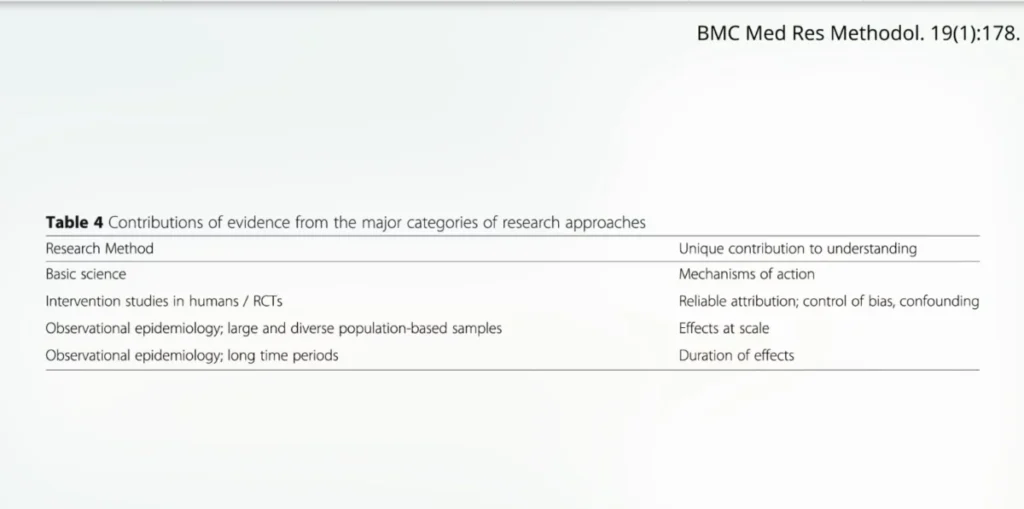
- HEALM (Hierarchies of Evidence Applied to Lifestyle Medicine): Another specialized framework developed because existing tools like GRADE are often not feasible or appropriate for questions that cannot be fully addressed through randomized controlled trials. HEALM acknowledges that each research method offers a unique contribution to the overall understanding of lifestyle medicine.
These developments represent a proactive "official response" from the scientific community, providing more suitable instruments for evaluating the multifaceted evidence in nutrition and lifestyle research, thereby counteracting the strategic misapplication of tools like GRADE.
The Power of Complementary Evidence: Building a Stronger Case
A comprehensive understanding of any complex health issue, especially diet, rarely comes from a single study type. Instead, it emerges from the convergence of multiple lines of evidence, each contributing a unique piece to the puzzle.
- Laboratory Studies: Explore exact biological mechanisms at cellular or animal levels, providing foundational understanding.
- Randomized Controlled Trials (RCTs): Can establish cause-and-effect for specific, short-term interventions, often focusing on surrogate markers.
- Population Studies (Observational): Track hundreds of thousands of people over decades, revealing long-term associations and real-world patterns that RCTs cannot capture.
The Trans Fat Success Story:
The triumph over trans fats serves as a powerful testament to the efficacy of this multi-pronged approach. Early randomized controlled trials demonstrated that trans fats increased risk factors for heart disease. Simultaneously, large-scale population studies showed a clear dose-response relationship: the more trans fats people consumed, the higher their incidence of heart disease. While "hard endpoint" RCTs – randomizing people to consume canisters of Crisco daily for years to observe heart attacks and deaths – were never conducted (and would be unethical), the combined weight of evidence built an irrefutable case. Consequently, trans fats were largely removed from the U.S. food supply, a public health intervention estimated to prevent as many as 200,000 heart attacks annually. This case vividly illustrates that "the perfect should not be the enemy of the good" when tens of thousands of lives are at stake.
Public Health Pragmatism: Lessons from Environmental Toxins:
The necessity of relying on diverse evidence sources extends beyond diet. Public health officials routinely establish tolerable upper limits for environmental contaminants like lead exposure or PCBs without the benefit of RCTs. No ethical researcher would randomize children to ingest varying amounts of lead to observe the development of brain damage. Instead, evidence is painstakingly gathered from animal studies, epidemiological observations, and toxicology research to make the best possible approximations for public safety. This pragmatic approach underscores that for many critical public health decisions, especially those involving long-term exposures or ethical limitations, observational data are not just helpful but indispensable.
The Meat Industry’s Echo: A Pattern of Manufactured Doubt
The strategy pioneered by the sugar industry has found a clear parallel in the meat industry. Observational studies have provided a wealth of evidence linking nutritional factors to various cancers, such as red meat consumption increasing colorectal cancer risk. If dietary guidelines for cancer prevention were to be assessed solely through the drug-designed GRADE approach, they would predictably be deemed "low quality."
Unsurprisingly, a meat industry-funded institution subsequently hired the same individual instrumental in conceiving and designing the sugar industry-funded study. This individual then became the lead author of a paper similarly arguing that dietary guidelines recommending reduced red and processed meat consumption could be ignored because, using GRADE methods, the evidence was rated as "low quality." This consistent pattern of industry-funded researchers employing a method known to undervalue lifestyle research to undermine unfavorable dietary guidelines reveals a deliberate and strategic effort to sow doubt and protect commercial interests. While current dietary guidelines consistently recommend limiting meat consumption, these industry-backed papers predictably concluded that the evidence supporting such recommendations was "of low quality."
The Irony of Inconsistency: A Self-Serving Critique
Adding a layer of profound irony to the sugar paper’s critique is its use of historical inconsistency in sugar guidelines to raise concerns about their overall quality. The authors highlighted variations in specific recommendations over a 20-year period as evidence of untrustworthiness. However, this critique conveniently overlooks a crucial detail: the most recent guidelines demonstrate "remarkable consistency," with one glaring exception. This outlier, a 2002 Institute of Medicine guideline suggesting that a quarter of one’s diet could consist of straight sugar without inducing deficiencies, was partly funded by an institute whose benefactors included major players like Coke, PepsiCo, and prominent cookie and candy companies. The profound irony is that the very entities that historically contributed to inconsistent guidelines are now weaponizing that inconsistency – in part of their own making – to argue that dietary advice cannot be trusted.
Implications and the Path Forward
The corporate assault on nutrition science, particularly the selective critique of observational studies, carries profound implications for public health, policy-making, and public trust.
- Erosion of Public Trust: When influential industries repeatedly cast doubt on well-established dietary recommendations, it fosters confusion and skepticism among the public, making it harder for individuals to make informed health choices.
- Stifling Policy Action: Manufacturing doubt provides a convenient pretext for policymakers to delay or resist implementing public health interventions, such as taxes on sugary drinks or stricter regulations on processed foods, which could significantly improve population health.
- Continued Health Burden: Delaying the adoption of healthier dietary patterns, driven by industry-funded disinformation, directly contributes to the ongoing burden of diet-related chronic diseases, leading to preventable suffering and escalating healthcare costs.
The ongoing battle over the legitimacy of nutrition science underscores the critical need for vigilance. As consumers of health information, it is imperative to critically evaluate sources, understand the methodologies behind scientific findings, and recognize the potential for industry influence. The scientific community’s development of specialized tools like NutriGrade and HEALM represents a robust and necessary "official response" to these challenges, providing a more appropriate framework for assessing the totality of evidence in nutrition.
Ultimately, public health officials must work with the best available balance of evidence. Demanding an unattainable "perfect" standard of evidence, often championed by industries with financial stakes, risks letting the perfect be the enemy of the good, delaying crucial public health action, and perpetuating preventable illness. The complex reality of diet and health necessitates a holistic approach to evidence, embracing the unique contributions of all valid research methodologies, rather than succumbing to a narrow, industry-driven critique designed to serve profit over public well-being.
Doctor’s Note Reiteration (Integrated Conclusion)
This discussion is the third in an eight-part series examining the profound impact of industries on dietary and health guidelines. Previous installments delved into the strategic efforts to undermine sugar consumption recommendations, including "How Big Sugar Undermines Dietary Guidelines" and "How Big Sugar Manipulated the Science for Dietary Guidelines." The upcoming segments will further explore recent controversial articles concerning meat consumption published in the Annals of Internal Medicine, continuing to shed light on the pervasive influence of corporate interests in shaping public health narratives and recommendations. Understanding these dynamics is crucial for anyone seeking clarity in the often-confusing world of nutrition science.