The Rise of Velo-Tourism: Why Oenophiles are Trading Tasting Rooms for Handlebars
By Lydia Price
September 25, 2026
The modern traveler is no longer satisfied with the passive consumption of leisure. As the appetite for "active wellness" continues to reshape the global travel industry, an unlikely but harmonious marriage has formed: the convergence of high-performance cycling and world-class viticulture. It is a logical evolution; the very geographic topography that produces the world’s most complex grapes—dramatic elevation changes, nutrient-rich soil, and diverse microclimates—also happens to provide the world’s most exhilarating cycling routes.
The Intersection of Sweat and Terroir: Main Facts
At its core, velo-tourism (cycling-based travel) offers a visceral connection to the land that a car window simply cannot provide. When a cyclist pedals through a vineyard, they are engaging with the "terroir"—the environmental factors that give a wine its unique character—on a sensory level. The cooling breeze on a hillside, the texture of the soil, and the specific orientation of the vines become part of the rider’s lived experience before the first glass of the day is ever poured.

This trend is not merely anecdotal; it is a significant shift in luxury travel behavior. Travelers are increasingly prioritizing itineraries that integrate physical exertion with culinary rewards, moving away from the traditional, sedentary "wine tour" model toward immersive, calorie-burning adventures that end in a cellar door.
A Chronological Shift in Travel Preferences
The trajectory of this movement can be traced back over the last decade, transitioning from niche hobbyist activity to a primary travel motivation.
- Pre-2020: Cycling wine tours were primarily viewed as luxury excursions for highly experienced road cyclists, often limited to organized, high-end group tours in regions like Tuscany or the Loire Valley.
- 2021–2023: The global pandemic triggered a surge in interest for outdoor-centric, socially distanced travel. As fitness became a priority for many, the demand for bike-friendly hospitality infrastructure grew.
- 2024–2026: The maturation of the electric bike (e-bike) market has acted as a catalyst. By lowering the barrier to entry, e-bikes have democratized the "wine-and-ride" experience, allowing casual cyclists to conquer terrain—such as the formidable slopes of Mont Ventoux or the Douro Valley—that would have previously been reserved for semi-professional athletes.
Supporting Data: The Growth of the Saddle-to-Stem Market
Industry leaders are reporting double-digit growth in bookings that pair cycling with regional tourism. According to Katy Rockett, regional director of North America at the tour operator Explore Worldwide, the data is compelling. "Our Porto to Lisbon cycling trip has seen bookings increase 31% year over year," she notes. "Even more impressively, our Lisbon to the Algarve trip is seeing growth, with bookings up 40%."

These numbers reflect a deeper shift in consumer psychology. "Traveling by bike puts you directly into the landscape," Rockett explains. "You are riding through the very vineyards, agricultural corridors, and small villages that produce the wine. There is an intrinsic, strengthened connection between the liquid in the glass and the geography you just traversed."
Official Responses and Industry Adaptation
The hospitality industry has responded in kind, with high-end properties pivoting their amenities to cater specifically to this demographic.
Dagmar Lombard, general manager of Hôtel Crillon le Brave in southeastern France, notes that the rise of the e-bike has been the single most important factor in the sector’s expansion. "Pairing cycling with wine tourism answers a growing demand for immersive, active experiences," Lombard says. "The e-bike has made this far more accessible—both for exploring the local vineyards and for taking on serious challenges like the ascent of Mont Ventoux."

Properties are now undergoing "cycle-friendly" certifications, such as the Accueil Vélo designation in France, which mandates secure storage, bike repair tools, and route-planning services. This shift signals that the "wine hotel" of the future is no longer just a place to sleep; it is a hub for athletic performance.
Global Destinations for the Two-Wheeled Oenophile
1. Provence, France: The Roman Roads
In the bucolic hills of southeastern France, cyclists navigate ancient Roman roads and fragrant lavender fields. The ultimate test remains the grueling Mount Ventoux, a frequent Tour de France stage. Beyond the physical challenge, the summit offers an otherworldly, moon-like vista of the Rhône Valley. Post-ride, the region’s legendary, mineral-tinged rosés serve as the perfect recovery drink.
2. Douro Valley, Portugal: The Terraced Challenge
A UNESCO World Heritage site, the Douro is not for the faint of heart. Vines cling to schist-cut slopes, creating a dramatic, vertical landscape. Cyclists here are treated to a masterclass in viticulture, passing iconic quintas—historic estates like the Symington Family’s Quinta do Vesúvio. The reward for the punishing gradient? Some of the world’s most coveted vintage Ports and sophisticated dry table wines.

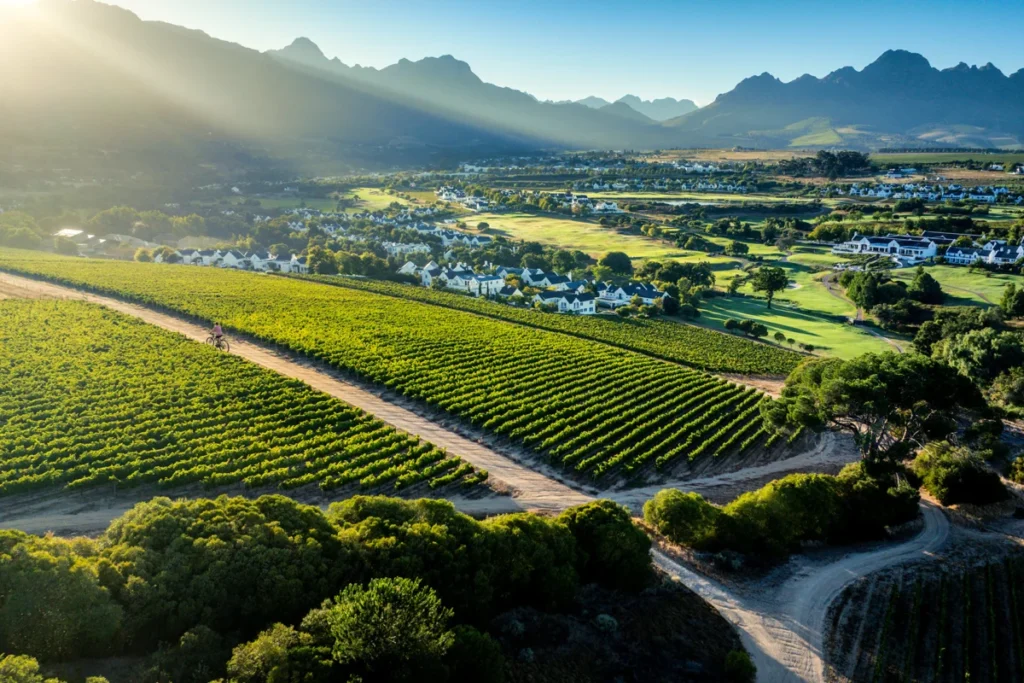
3. Stellenbosch and Franschhoek, South Africa: The Cape Winelands
The Cape offers a diverse playground, from technical mountain bike trails in the Simonsberg Mountains to smooth, paved lanes in the valley. Riding the Helshoogte Pass is a rite of passage. Stops like Delaire Graff offer a glimpse into luxury, where riders can transition from dusty trails to private pool terraces in moments.
4. Sonoma Valley, United States: The Diverse AVA
With 19 distinct AVAs, Sonoma offers more variety than its neighbor, Napa. North Sonoma, specifically the Healdsburg area, provides quiet, undulating roads. A 10-mile stretch on West Dry Creek Road offers over a dozen wineries. The region’s diversity—ranging from redwood forests to rugged coastlines—ensures that every cyclist finds their ideal topography.
5. The Loire Valley, France: The "La Loire à Vélo"
Central France is home to a 560-mile dedicated trail that follows the river past Renaissance châteaux. For those seeking a unique twist, the Via Allier leads into the volcanic hills of the Côtes d’Auvergne, where one can sample Gamay and Pinot Noir from vineyards rooted in ancient volcanic soil.

6. Barossa Valley, Australia: The Accessible Trail
For those seeking a more relaxed pace, the 25-mile Barossa Trail is a sealed path that traverses the heart of Australia’s wine country. It is designed for convenience, with public water stations and frequent cellar door access, including the historic Seppeltsfield estate, home to legendary 100-point red blends.
7. Girona and the Empordà, Spain: The Catalan Loop
Girona has long been the training ground for professional cyclists, but its proximity to the DO Empordà makes it a premier wine destination. Riders can loop through cork forests and medieval villages before hitting the coast. The Pirinexus route offers a mix of road and gravel, leading to views where the Mediterranean meets the Pyrenees.
8. Willamette Valley, United States: The Pinot Noir Corridor
Oregon’s 134-mile Scenic Bikeway is a masterclass in pastoral beauty. The route winds through hazelnut orchards and hop fields, passing by producers like Ankeny Vineyard. It is a quintessential multi-day trip for those who prefer cool-climate Pinot Noir and lush, green landscapes.

9. Tuscany, Italy: The Spiritual Home of the Ride
Cycling is as much a part of the Tuscan identity as Sangiovese. With over 9,000 miles of routes, the region offers everything from gentle cypress-lined white gravel roads (strade bianche) to the brutal climbs of the Garfagnana. It is arguably the most culturally rich cycling destination on Earth.
Implications for the Future of Travel
The rise of velo-tourism represents a permanent shift in how we value travel time. As travelers move away from the "checklist" approach to tourism, they are finding that the effort required to reach a destination—the sweat, the planning, and the physical endurance—actually enhances the appreciation of the destination itself.
When a visitor arrives at a winery by bike, they are not just a customer; they are a participant in the local ecosystem. They have seen the terrain that gives the wine its character, and they have earned their glass through physical exertion. As infrastructure continues to improve and e-bikes become even more efficient, the intersection of cycling and wine will likely transition from a niche interest to a pillar of luxury and sustainable travel in the coming decade. Whether you are a professional athlete seeking a challenge or a hobbyist seeking the perfect glass, the world’s vineyards are calling—and they are best viewed from the saddle.