Unmasking Influence: Accusations Against the International Life Sciences Institute and the Shadowy Battle for Dietary Guidelines
Washington D.C. – In a world increasingly conscious of health and nutrition, the integrity of dietary guidelines is paramount. These recommendations, intended to steer populations towards healthier lives, are meant to be beacons of unbiased scientific consensus. However, a deepening controversy has cast a long shadow over this trust, with the International Life Sciences Institute (ILSI), a seemingly benign nonprofit, standing accused of acting as a sophisticated front group for some of the world’s largest food, beverage, and pharmaceutical corporations, including giants like Coca-Cola. Critics argue that ILSI has systematically worked to undermine scientific advice that threatens its funders’ commercial interests, echoing tactics once famously employed by the tobacco industry.
This high-stakes battle for the narrative around what constitutes healthy eating has played out dramatically in recent years, particularly concerning recommendations on sugar and red meat consumption. Public health advocates and investigative journalists point to a disturbing pattern where scientific reviews, often led by the same researchers, produce conclusions that align suspiciously well with the agendas of major food industry players, even when contradicting prevailing scientific evidence on the risks of premature death, cardiometabolic disease, and cancer.
Main Facts: A Nonprofit Under Fire
The International Life Sciences Institute (ILSI), a global non-profit organization, is facing severe scrutiny and accusations of operating as a covert lobbying arm for its corporate benefactors. Founded by a top Coca-Cola executive, ILSI draws nearly its entire $17 million budget from approximately 400 corporate members, including powerful entities like Coca-Cola, PepsiCo, Hershey, Red Bull, and the makers of Oreos. Despite its stated mission to "improve human health and well-being," critics contend that ILSI’s primary function is to shape food policy worldwide in a manner favorable to its funders’ commercial interests.
The controversy reached a fever pitch with two distinct but interconnected events:
- The Sugar Guidelines Undermining (2016): Following the 2015 U.S. Dietary Guidelines for Americans recommending reduced sugar intake, ILSI sponsored a review published in the Annals of Internal Medicine. This review, led by researcher Bradley Johnston, controversially concluded that existing guidelines on dietary sugar were untrustworthy and based on low-quality evidence, effectively advising against sugar reduction. Subsequent investigations by the Associated Press revealed direct corporate influence over the study, forcing the journal to publish a correction and exposing an undisclosed $25,000 grant to a co-author from Coca-Cola.
- The Red and Processed Meat Recommendations (2019): In a striking parallel, a series of reviews also published in the Annals of Internal Medicine in 2019, again with Bradley Johnston as lead author, examined the health impacts of red and processed meat. Despite acknowledging that lower intake was associated with decreased risks for premature death, cardiometabolic disease, and cancer, the accompanying dietary guideline recommendations bizarrely advised individuals to "continue current unprocessed red meat consumption" and "continue current processed meat consumption." This conclusion, dubbed the "Big Beef" playbook, directly contradicted the implications of the scientific findings and sparked widespread outrage among public health experts.
These instances highlight a systemic problem where corporate funding is alleged to bias scientific outcomes, leading to recommendations that potentially endanger public health for commercial gain.
Chronology of Influence: From Sugar to Salami
The story of ILSI’s alleged influence unfolds over several years, revealing a pattern of strategic intervention at critical junctures in dietary policy development.
2015: The Sugar Reckoning
The narrative begins in earnest in 2015, when the U.S. Dietary Guidelines for Americans, a cornerstone of public health advice, had the "audacity" to recommend a reduction in sugar intake. For the sugar industry, this was a direct threat to their bottom line. The scientific consensus was increasingly firm: excessive sugar consumption contributes significantly to obesity, type 2 diabetes, heart disease, and other chronic illnesses. Faced with overwhelming evidence, the industry allegedly turned to a well-worn playbook – one honed by the tobacco industry decades prior.
The Tobacco Playbook: A Disturbing Precedent
To understand ILSI’s alleged tactics, one must look back at the history of the tobacco industry. When confronted with irrefutable evidence of its products’ harm, the tobacco industry engaged in extensive campaigns to "cast doubt on the science." A key method involved "funding of and involvement in seemingly unbiased scientific groups to manipulate political and scientific debate concerning tobacco and health." The article explicitly states that ILSI itself "has enjoyed a long and serious collaboration with the tobacco industry," establishing a deeply troubling historical precedent for its current activities. This connection suggests a shared strategy: rather than refute scientific evidence directly, create a perception of scientific uncertainty.
2016: Undermining Sugar Guidelines
In the wake of the 2015 sugar recommendations, ILSI sprang into action. It sponsored a review, published in December 2016 in the prestigious Annals of Internal Medicine, titled "The Scientific Basis of Guideline Recommendations on Sugar Intake." The lead author for this critical review was Bradley Johnston. The paper’s conclusion was stark: "Guidelines on dietary sugar do not meet criteria for trustworthy recommendations and are based on low-quality evidence." This directly challenged the official U.S. guidelines, providing a seemingly scientific basis for consumers and policymakers to disregard the advice to reduce sugar.
The paper quickly drew sharp criticism. Professor Marion Nestle, a renowned expert in nutrition, famously stated, "This comes right out of the tobacco industry’s playbook: cast doubt on the science. This is a classic example of how industry funding biases opinion. It’s shameful." Indeed, the funding sources for the paper were revealed to include major industry players like Hershey, Red Bull, Coca-Cola, and the manufacturers of Oreos.
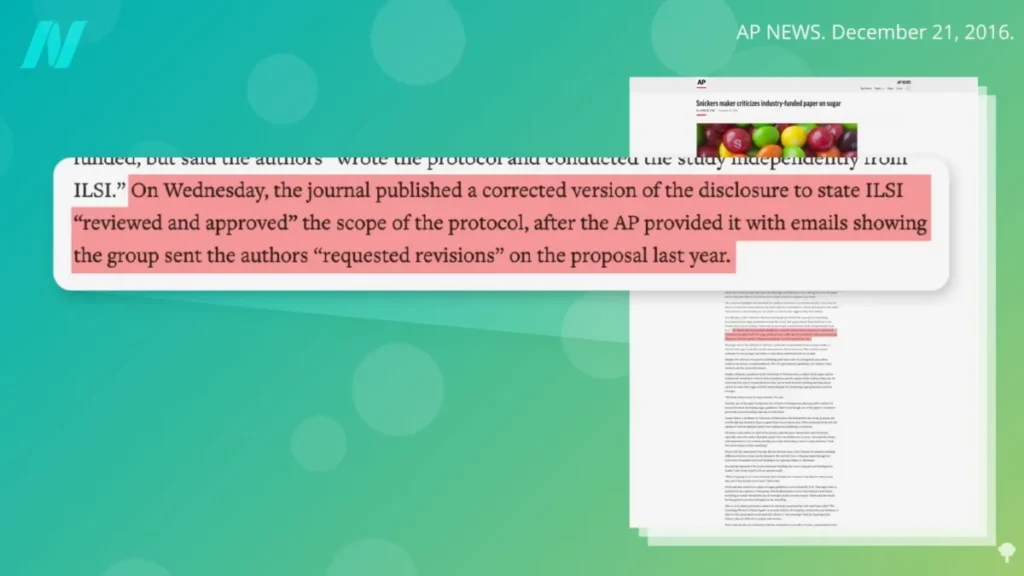
Crucially, the authors of the 2016 paper initially "swore they wrote the protocol and conducted the study independently from ILSI." However, an investigation by the Associated Press unearthed emails demonstrating that ILSI, acting on behalf of its industry funders, "requested revisions" to the paper. This exposé forced the Annals of Internal Medicine to publish a corrected version, acknowledging the direct influence. Furthermore, it came to light that a co-author had "conveniently forgot" to disclose a $25,000 grant directly from Coca-Cola, a significant conflict of interest that further eroded the paper’s credibility.
In a surprising turn, even Mars, the confectionery giant behind Snickers and M&M’s, and itself a member of ILSI, broke ranks to denounce the industry-funded paper. The company reportedly felt that such overt attempts to undermine health guidelines "just makes us all look bad," highlighting the reputational damage associated with such perceived manipulation.
2019: The Red Meat Paradox
Fast forward four years. As the next batch of Dietary Guidelines for Americans was being formulated, the scientific report of the guidelines committee encouraged diets not just lower in sugar but also lower in meat. This presented a new challenge for the meat industry.
Once again, the playbook allegedly deployed by "Big Sugar" was adapted by "Big Beef." In September 2019, a series of reviews was published in the Annals of Internal Medicine. These reviews consistently concluded that adhering to dietary patterns lower in red or processed meat intake was associated with decreased risks for premature death, cardiometabolic disease and mortality (including heart disease and type 2 diabetes), and cancer.
Despite these clear findings, the accompanying Dietary Guideline Recommendations, again led by the same researcher, Bradley Johnston, concluded: "continue current unprocessed red meat consumption" and "continue current processed meat consumption." This jarring disconnect between the scientific evidence presented and the final recommendations shocked public health experts and fueled further accusations of industry influence. The use of the same journal and the same lead author as the controversial sugar review only intensified suspicions that a coordinated strategy was at play to protect commercial interests over public health.
Supporting Data: The Bias of Funding
The accusations against ILSI and its corporate funders are not isolated incidents but fit into a broader pattern observed in nutrition science. Decades of research have demonstrated a clear and concerning correlation between funding sources and research conclusions.

Studies examining the relationship between funding sources and conclusions in nutrition-related scientific articles consistently reveal a significant bias. Research indicates that industry-funded studies are approximately seven to eight times more likely to skew favorably towards the products of their funders compared to studies conducted without industry backing.
Even more starkly, for interventional studies – those directly testing the effects of a product or dietary component – the proportion of industry-funded studies that reached unfavorable conclusions about their own products was a "whopping 0%." This statistic, while perhaps unsurprising to cynical observers, is deeply troubling for the scientific community and public health advocates. It suggests a fundamental conflict of interest that can compromise the objectivity and integrity of research.
The mechanism of this bias can be subtle. It might involve the selection of research questions, the design of studies (e.g., choice of comparators, duration), the interpretation of results, or even the selective publication of favorable findings while suppressing unfavorable ones. When a research institution or individual researcher relies heavily on industry funding, even subconsciously, there can be pressure to produce results that do not alienate their patrons. The case of the undisclosed $25,000 grant to a co-author of the ILSI-sponsored sugar paper underscores how financial ties can influence scientific output and ethical disclosure.
The global reach of ILSI further amplifies these concerns. Described as "quietly infiltrating government health and nutrition bodies around the world," ILSI’s influence extends far beyond U.S. borders. The New York Times reported in 2019 that ILSI "shapes food policy worldwide," specifically citing its activities in India, Brazil, and China. This global footprint means that potentially biased research and policy recommendations could affect public health on a massive scale, impacting diverse populations and contributing to the global burden of diet-related diseases.
Official Responses and Calls for Reform
While ILSI and its corporate members often maintain that their funding is transparent and that researchers operate independently, the evidence of direct interference, as revealed by the Associated Press investigation into the sugar paper, undermines these claims. The journal Annals of Internal Medicine‘s decision to publish a correction after industry influence was proven is a significant official acknowledgment of the breach of scientific integrity. However, such corrections often come long after the initial, potentially misleading, conclusions have permeated public discourse.
The scientific community, particularly leading journal editors, faces increasing pressure to address this pervasive issue. Experts like Marion Nestle and others have consistently advocated for stronger measures to protect the integrity of scientific discourse from commercial interests.
One proposed solution, drawing directly from the historical precedent of the tobacco industry, is for high-quality scientific journals to outright "refuse to be passive conduits for articles funded by the tobacco industry." This policy, adopted by many leading medical journals, effectively blocks industry-funded tobacco research from publication, recognizing the inherent conflict of interest and the industry’s history of obfuscation.
Advocates argue that a similar stance should be adopted for industries with commercial interests in the outcomes of nutrition research, particularly concerning products like added sugars and processed meats. "Accordingly, high-quality journals could refrain from publishing studies on health effects of added sugars funded by entities with commercial interests in the outcome—like soda and cookie companies."
The fact that the ILSI-sponsored reviews on sugar intake and red/processed meat were published in the Annals of Internal Medicine, a highly respected journal, despite the evident conflicts, highlights the ongoing challenge. While journals have mechanisms for conflict of interest disclosure, these have proven insufficient when authors fail to disclose or when influence is exerted subtly or indirectly. The call for outright rejection of industry-funded studies on specific topics is a radical but increasingly discussed measure aimed at restoring public trust and safeguarding scientific independence.
Implications: Eroding Trust and Public Health Risks
The alleged activities of ILSI and the pattern of industry-funded research carrying conclusions favorable to its patrons carry profound implications for public health and the public’s trust in science.
Compromised Public Health: Dietary guidelines are vital tools for public health. They inform government policy, guide food production, influence healthcare professionals, and empower individuals to make healthier choices. When these guidelines are perceived as compromised by commercial interests, the consequences can be devastating. Misleading or diluted advice on sugar and meat consumption can contribute to the ongoing epidemics of obesity, type 2 diabetes, cardiovascular disease, and certain cancers. The direct health risks associated with continued high intake of red and processed meats, as well as added sugars, are well-established. If the public is advised to "continue current consumption" despite these risks, it actively works against efforts to improve national and global health.
Erosion of Scientific Integrity: The credibility of scientific research hinges on its independence and objectivity. When industry funding consistently correlates with favorable outcomes, it undermines the very foundation of scientific inquiry. The exposure of undisclosed financial ties and direct corporate interference in published research damages the reputation of researchers, journals, and the scientific process as a whole. This erosion of trust can make it harder for the public to distinguish between genuine scientific consensus and industry-driven narratives, leading to confusion and inaction on critical health issues.
Policy Paralysis: Beyond individual dietary choices, dietary guidelines inform policy decisions related to food labeling, school lunch programs, public health campaigns, and agricultural subsidies. If these guidelines are influenced by corporate agendas, they can lead to policies that prioritize commercial profits over public health, perpetuating unhealthy food environments. The ability of groups like ILSI to "infiltrate government health and nutrition bodies" suggests a deeper, more systemic problem where industry influence may extend directly into policymaking processes.
Global Impact: Given ILSI’s global presence, the implications extend worldwide. Developing nations, often grappling with rising rates of diet-related chronic diseases, may be particularly vulnerable to industry-influenced advice that promotes less healthy dietary patterns. This can exacerbate global health inequalities and complicate international efforts to address the challenges of malnutrition and diet-related non-communicable diseases.
In conclusion, the allegations against the International Life Sciences Institute represent more than just a dispute over scientific findings; they represent a fundamental challenge to the integrity of public health guidance. The parallels drawn with the tobacco industry’s historical tactics serve as a stark warning about the potential for corporate interests to systematically undermine scientific consensus for financial gain. Restoring public trust and safeguarding health require not only vigilance but also a concerted effort by scientific journals, policymakers, and the public to demand greater transparency, stricter ethical standards, and genuine independence in the formulation of dietary advice. The battle for what goes on our plates, and in our guidelines, is far from over.